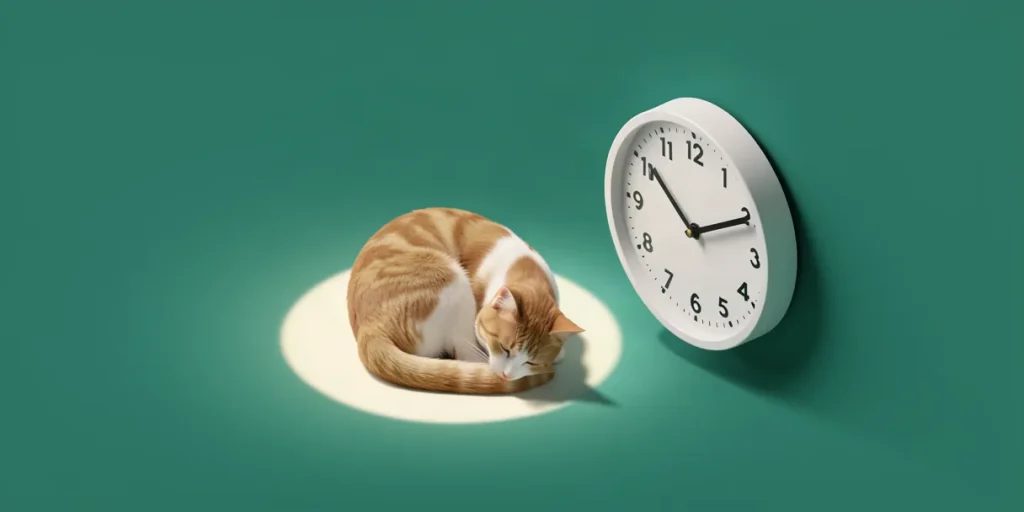
Cats usually sleep around 12–16 hours a day, while kittens and senior cats may rest longer. What’s normal depends on your pet’s age, activity level, and general health.
It’s important to look beyond the number of hours and consider your cat’s habits: a sudden change in sleep, lethargy, or unusual restlessness may be a reason to pay closer attention to their health. Let’s look at age-based sleep norms and signs that mean it’s time to consult a veterinarian.
| Age or condition | Sleep per day | What to keep in mind |
|---|---|---|
| First weeks of life | Up to 23 hours | Long periods of sleep are typical for kittens |
| One month old | 20–22 hours | Compare with the kitten’s routine as they grow |
| Adult cat | 12–15 hours | Take the cat’s individual routine into account |
| After spaying or neutering | 14–17 hours | Monitor overall health and activity |
| Senior age | Up to 20 hours | Sudden changes need attention |
- 12–16 hours a day A cat’s typical sleep duration
- up to 20 hours a day Possible sleep duration in old age
- up to 23 hours a day Possible sleep duration for a kitten in its first weeks
- no more than 25% The share of REM sleep in total sleep time
How many hours a day does a cat normally sleep?
A general guideline for cats is 12–16 hours of sleep a day, but individual cats’ needs vary. Adult cats typically sleep 12–15 hours; after spaying or neutering, they may sleep 14–17 hours. These figures should therefore be treated as guidelines, not a one-size-fits-all standard for every pet.
How to assess your cat’s sleep
A senior cat may sleep up to 20 hours a day. When assessing sleep, consider not only the total time spent resting but also the individual animal’s usual routine: when they typically sleep, how active they are while awake, and whether their schedule has changed.
If your cat has started sleeping noticeably more or less, compare their current behavior with what’s normal for them. A brief departure from their usual schedule doesn’t by itself indicate a problem, but a significant or ongoing change is a reason to watch your pet more closely and discuss their condition with a veterinarian.
How does a kitten’s sleep change with age?
Kittens usually sleep longer than adult cats, and their sleep time decreases as they grow: in the first weeks of life, a kitten may sleep up to 23 hours a day, and at around one month old, 20–22 hours. So assess their routine according to their age, rather than comparing it with an adult pet’s habits.
In the first weeks, frequent sleep is a normal part of a kitten’s routine: rest periods alternate with feeding and short bursts of activity. At around one month old, kittens may still sleep a great deal, but they gradually begin staying awake longer and exploring their surroundings more actively.
When to be concerned
A lot of sleep isn’t a problem in itself if it’s appropriate for the kitten’s age and their behavior hasn’t changed. Talk to a veterinarian if your pet has become noticeably less active or their usual sleep schedule has changed abruptly.
How does a cat’s sleep work, and why do they wake up so often?
Cats wake up often because their sleep consists of alternating phases, and they may doze in short stretches. Waking up like this doesn’t in itself mean that your pet isn’t getting enough sleep: their overall health and usual sleep routine matter.
Light and REM sleep
During the light-sleep phase, a cat remains alert to sounds and movements around them, so they can wake easily. The light-sleep phase lasts 15 to 30 minutes; the phases then alternate.
The REM-sleep phase lasts 5 to 10 minutes and makes up no more than 25% of total sleep time. Short periods of rest with wakeful intervals in between are a normal feature of feline sleep, not sufficient evidence of sleep deprivation.
Why has my cat started sleeping more or less?
A cat may sleep more or less because of their age, temperament, hormonal status, health, and home environment. So assess changes against your own pet’s usual routine, not by comparing them with another breed.
Spaying or neutering may be accompanied by longer sleep, but consider this alongside activity and appetite. A cat that sleeps more but still eats eagerly and plays at their usual times is not the same as one whose appetite and interest in moving have also declined. A noticeable change in routine, especially alongside other changes in health, is a reason to consult a veterinarian.
Other factors that affect sleep patterns
- Age. Kittens and senior cats usually sleep longer than adult animals.
- Weather and indoor temperature. Changes in conditions may affect how much a cat rests and how willing they are to move around.
- Diet. A change in food or feeding schedule may coincide with a change in your pet’s behavior.
- Individual routine. Compare sleep duration and periods of activity with how your cat usually behaves at home.
When is a change in sleep a reason to see a veterinarian?
See a veterinarian if your cat’s sleep duration changes suddenly—either increasing or decreasing—and the change persists. Their behavior during their usual waking hours matters just as much as their sleep pattern.
Changes to look out for
Don’t put unusual sleepiness down to age alone if your cat’s appetite, activity, or usual behavior has also changed. Tell your veterinarian what’s different—for example, if your pet is eating less, playing less often, or no longer greeting you at the door when that used to be part of their routine.
Restless sleep is also worth discussing with a specialist: your cat wakes often, can’t settle comfortably, or keeps moving from one spot to another. Don’t give your pet medication or adjust an existing treatment on your own. A veterinarian should assess the cause of the change in sleep; before your visit, it may help to note when the changes began and what else has changed in your cat’s condition.
What mistakes can get in the way of assessing a cat’s sleep?
It’s hard to assess a cat’s sleep accurately if you judge it only by how still they appear, how many hours they sleep, or by comparing them with an animal of a different age. A cat may be dozing while remaining alert: they respond quickly to a sound or movement, and this kind of rest doesn’t necessarily mean they’re in a deep sleep.
Don’t wake your cat just to check whether they’re asleep: interrupting them disrupts their normal rest and doesn’t show how they behave in everyday conditions. It’s better to observe their usual routine and note any changes in appetite, energy, or behavior. The number of hours a cat sleeps isn’t enough to assess their health: a sudden change in habits is cause for concern, especially if their overall condition has changed at the same time.
Take your cat’s age into account
Sleep needs change with age, so kittens, adult cats, and senior cats shouldn’t all be judged by the same standard. For example, kittens may sleep up to 23 hours a day in their first weeks, while senior cats may sleep up to 20 hours. Above all, compare your pet with their own usual routine, paying attention to appetite, activity, and sudden behavioral changes.
Frequently asked questions
Is it normal for an adult cat to sleep almost all day?
How much does a kitten sleep in its first month?
Why does a cat sleep more after being spayed or neutered?
Should I wake my cat if they’ve been sleeping for a long time?
Key takeaways
- A general guideline for cats is 12–16 hours of sleep a day.
- A senior cat may sleep up to 20 hours, while a kitten in its first weeks may sleep up to 23 hours.
- The light-sleep phase lasts 15 to 30 minutes; sleep consists of alternating phases.
- A sudden, lasting change in sleep is a reason to discuss your cat’s condition with a veterinarian.
Sources
- purina.ru — “How many hours a day do cats sleep? Average sleep norms and duration”
- SHEBA® — “How many hours a day do cats sleep, and why do cats sleep so much?”
- goodhands.vet — “How many hours a day do cats sleep, and why so much? — ‘In Good Hands’ veterinary clinic”
- royalcanin.ru — “How many hours a day do cats sleep? Sleep norms by age”
- bethowen.ru — “How much should a cat sleep per day? Sleep norms for cats”