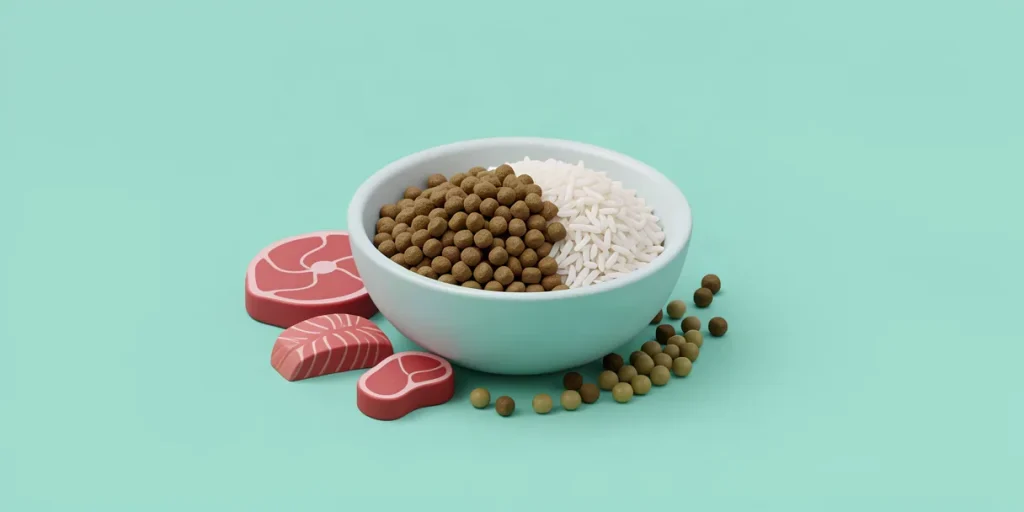
Protein in pet food should be assessed by more than the percentage on the package: you also need to consider the type of pet, its age and health, the overall diet, and ingredient digestibility. Compare foods of the same type—for example, dry food with dry food—and check where the protein comes from.
A high number on its own does not mean the food is better or right for your pet. Let’s look at how to read the label and what to pay attention to in the ingredient list so you can assess protein thoughtfully rather than choosing a product based on a single figure.
| Source | Examples from the article | What to consider |
|---|---|---|
| Animal | Meat, poultry, fish | Amino acid profile and digestibility |
| Plant | Soy concentrate | May be highly digestible; assess nutritional value |
| Plant | Rice concentrate | The source name does not replace an assessment of the full formula |
| Plant | Pea concentrate | Do not judge quality by one overall percentage |
- 3 criteria Protein differs by source, amino acid profile and digestibility
- 70% Example of the share of protein from animal sources; this is not the percentage of meat in the food
- 3 sources Plant protein concentrates named: soy, rice and pea
- 3 sources Examples of animal proteins: meat, poultry and fish
Why doesn’t the same protein percentage mean the same nutritional value?
The same protein percentage does not mean the same nutritional value because the overall figure reveals neither where the protein comes from nor its amino acid profile or how well it is digested. For example, protein may come from meat, poultry or fish, as well as plant ingredients—in particular, soy, rice or pea concentrate. These sources differ in their amino acid profiles and nutritional value.
What else to consider when reading the label
Protein quality is assessed using three separate criteria: source, amino acid profile and digestibility. So the statement “70% protein from animal sources” indicates the share of protein from animal sources, but does not in itself mean that the food contains 70% meat.
When choosing food, compare its ingredients with the product’s intended use and your pet’s species: for example, check whether it lists meat, poultry or fish, or plant concentrates. One number on the label cannot replace this check: the same overall percentage can come from different sources and therefore does not, by itself, tell you whether the diet is complete.
How do animal and plant protein sources differ?
Animal and plant proteins differ in origin, essential amino acid profiles and nutritional value: meat, poultry and fish are considered more complete sources, while plant ingredients are assessed individually based on their composition and digestibility.
Animal sources in pet food include meat, poultry and fish. Their proteins are characterized by a more complete range of essential amino acids, so the total protein figure alone does not show how valuable the protein your pet receives is.
Plant ingredients include soy, rice and pea protein concentrates. They may be highly digestible, but digestibility alone does not mean their amino acid profiles and nutritional value match those of animal proteins. When comparing ingredients, it is therefore important to distinguish between two criteria: how well the protein is digested and which amino acids it provides.
How to read protein sources in the ingredient list
- Meat, poultry and fish are animal sources characterized by a more complete range of essential amino acids.
- Soy, rice and pea protein concentrates are plant ingredients; high digestibility does not make their nutritional value identical to that of animal proteins.
- The full formula provides necessary context for assessment: the words “animal” and “plant” tell you where an ingredient comes from, but do not replace an analysis of the food as a whole.
What do protein digestibility and biological value mean?
Digestibility indicates how effectively a pet’s body uses the protein it consumes, while biological value (BV) describes how well the protein suits the body in terms of digestion and amino acid profile. So when assessing pet food, the overall protein percentage is not the only thing that matters; its sources do too. Meat, poultry, fish and plant concentrates provide proteins with different properties.
How to assess protein sources
Even ingredients in the same category are not interchangeable: for example, soy, rice and pea protein concentrates differ in amino acid profile and digestibility. Animal proteins from meat, poultry and fish are described as sources of essential amino acids, but an ingredient’s name alone does not reveal the exact figures for a particular food.
- Meat, poultry and fish: consider them sources of animal protein, but do not assume that the name alone guarantees the same digestibility.
- Soy, rice and pea concentrates: these are distinct plant sources; they should not be grouped together as though they had the same nutritional value.
- Ingredient list: consider it alongside the overall protein percentage, since the percentage does not show which sources the protein comes from.
The exact BV cannot be determined from an ingredient name alone: the material provided gives no figures for specific foods. BV remains a useful point of reference when choosing food, but without composition and digestibility data, it cannot be assigned an exact number.
How do you read the list of protein ingredients on a package?
Read the list of protein ingredients by looking at the specific names, not just the overall protein figure: look for meat, poultry or fish, as well as plant ingredients such as soy, rice or pea protein concentrates. The source matters because proteins differ in amino acid profile and digestibility; the word “protein” alone is not enough to assess the formula.
Ingredients and figures are not the same thing
The overall protein figure on the package tells you the total amount of protein in the food, but not how much each ingredient contributes. So this figure cannot tell you, for example, how much protein comes from fish versus pea protein concentrate.
- “70% protein from animal sources” describes where the protein comes from, not the proportion of meat in the food: you cannot read this as “70% meat.”
- A named ingredient—for example, fish—refers specifically to that ingredient.
- A statement about the protein portion of the formula describes the overall origin of the protein and is not equivalent to a claim about the proportion of a specific ingredient.
When reading the label, consider both levels: which sources are listed in the ingredients and what exactly the percentage refers to. If the wording gives only the share of animal protein, it does not in itself reveal either the amount of meat or the contribution of each individual source.
When can comparing protein sources be misleading?
Comparing protein sources can be misleading if you judge food only by its protein percentage or the words on the package: these features alone do not show the amino acid profile or digestibility of the diet. A high figure therefore does not guarantee that the protein will provide your pet with the amino acids it needs, and the label “meat-based” does not prove that the whole food is complete.
- The highest percentage does not mean the greatest benefit. Proteins differ by source, amino acid profile and digestibility. One figure on the label does not tell you which amino acids are available to the animal or how efficiently its body will digest the protein.
- Plant-based does not mean useless. Soy, rice and pea protein concentrates may be highly digestible, although their nutritional value may be lower. It is therefore important to assess not only an ingredient’s origin but also its properties.
- The word “meat-based” does not confirm the quality of the whole diet. Completeness also depends on the amino acid profile and digestion of the protein, not just the name of one ingredient.
- A ranking for dogs cannot automatically be applied to cats. The comparative order of plant proteins is given for dog food; the material does not provide a similar ranking for cats.
When choosing food for a dog or cat, consider the protein source together with its amino acid profile and digestibility. Do not apply an assessment of one type of food to another species: the available comparison of plant sources applies specifically to dogs.
What practical conclusions can you draw when choosing pet food?
When choosing food, compare not only the protein percentage but also its source, amino acid profile and digestibility: one number on the package does not show how well the protein suits your pet. Check whether meat, poultry or fish are named specifically, or whether the formula lists plant concentrates.
- Meat, poultry and fish: assess each source individually; the fact that it is an animal protein does not in itself tell you how much meat the finished food contains.
- Soy, rice and pea concentrates: consider them plant protein sources and compare them with animal ingredients in terms of amino acid profile and digestibility.
- Share of animal protein: do not equate it with the percentage of meat. It indicates the origin of the protein, not the share of meat ingredients in the formula.
Assessing protein in pet food requires you to consider its origin, amino acid profile and digestibility together; the overall percentage alone is not enough to determine whether the food is complete. If the ingredient list does not specify which ingredients provide the protein, you cannot judge its quality from a single number on the front of the package.
Key takeaways
- The overall protein percentage is not a measure of protein completeness.
- Compare the source, amino acid profile and digestibility.
- Meat, poultry and fish are animal sources; soy, rice and pea concentrates are plant sources.
- A share of animal protein—for example, 70%—does not mean the food contains the same share of meat.
Frequently asked questions
Is knowing the protein percentage in pet food enough?
Is plant protein in pet food always worse?
If the label says 70% animal protein, does that mean the food contains 70% meat?
Which criteria should you consider when assessing protein quality?
Sources
- “For” and “Against” — “Protein in Dog and Cat Food”
- petobzor.com — “Protein in Cat and Dog Food: The Overall Figure Isn’t What Matters Most — PetObzor”
- t-j.ru — “How to Assess the Quality of Dog Food”
- permzoo.ru — “Breaking Down Pet Food Ingredients”
- bowlwow.com — “BVaap and Assessing Protein Quality in Pet Food”
