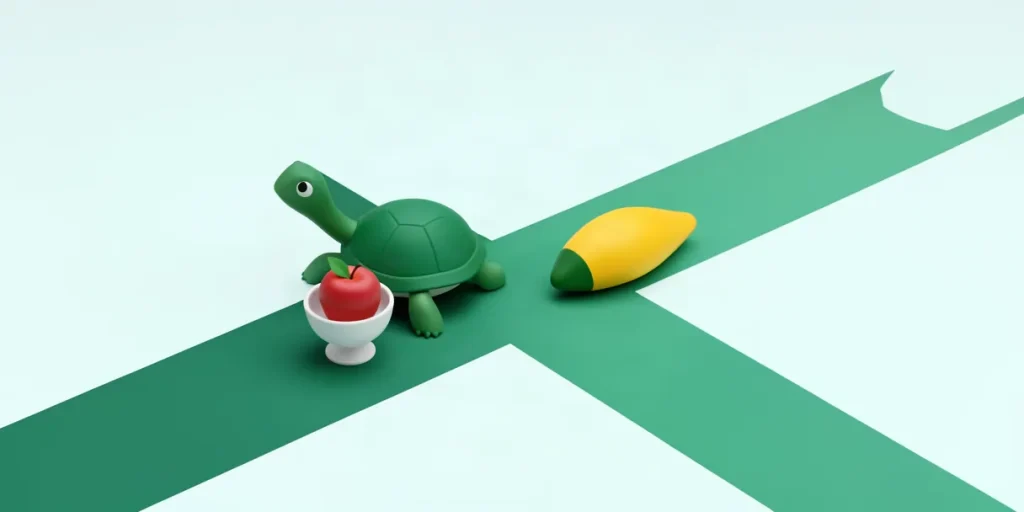
Turtles have memory: they remember routes, places where food is available, and familiar conditions. Exactly how long these memories last depends on what the turtle has learned and the situation in which it learned it.
So the question “what kind of memory do turtles have?” cannot be answered by simply comparing them with humans. What matters is what the animal remembers and how this shows up in its behavior.
| Ability | How it was tested | What can be concluded |
|---|---|---|
| Spatial memory | Remembering where tastier food was given | A turtle may remember an appealing feeding spot |
| Route memory | Repeating a route through a maze to a treat | A route is learned through repetition |
| Associative memory | Colored cards were linked with apple, mango, and portion size | A signal can be associated with a food reward |
| Conditioned response | Testing the response after removal of the main part of the forebrain | Retention of a response does not prove complex reasoning |
- more than 500 publications publications included in the data collection on sea turtles
- 150 experts experts involved in collecting data on sea turtles
- more than 42 thousand sea turtles annual legal catch
What kind of memory do turtles have, and what do they remember?
Turtles remember places where they received tastier food, associations between signals and food, and routes through a maze to a treat.
Places and routes
Spatial memory helps turtles retain information about where food is located. The reported memory of a place where tastier food was given lasted a year and a half.
Francesca, a red-eared slider, took part in a test of whether repetition helps a turtle remember a route through a maze to a treat. This is an example of route learning: the animal repeats actions and may associate them with the place where a reward is waiting.
Color and food
Yellow-footed tortoises were shown cards of different colors associated with apple, mango, and portion size. This kind of experiment tests associative memory—the ability to connect a signal with food.
- Place: where the turtle received tastier food.
- Route: the path through a maze to a treat that Francesca followed through repetition.
- Color signal: a card associated with apple, mango, or portion size.
How does memory show up in routes and familiar feeding routines?
A turtle learns a route to a treat by repeating the same path, and a regular feeding spot can become a familiar landmark.
In a maze experiment, the turtle has to find its way to the reward again: simply being introduced to the route is not enough to conclude that it has learned it. Repetition helps reinforce the association between movement and the treat. If the route changes abruptly, the turtle’s previous experience may no longer lead it to the food.
A regular feeding spot can also influence behavior. When food appears in the same place repeatedly, the turtle may remember where it is. Moving the bowl or feeding the turtle elsewhere changes its familiar route, so when observing its behavior, pay attention to exactly where the food is placed.
How a turtle associates a signal with food
In experiments with yellow-footed tortoises, researchers used colored cards to indicate different foods, such as apple and mango, as well as portion size. This shows that a visual signal can become associated with a particular food or its quantity.
- Route: Repeat the same path to the treat if you are testing whether the turtle remembers it.
- Place: Keep the feeding spot the same to assess whether the turtle uses it as a landmark.
- Card: Do not change what a color means while testing its association with food or portion size.
If you move the food, change the route, and replace the card all at once, it will be hard to tell exactly which signal the turtle responded to. For clear observations, keep the associations between the signal, location, and reward consistent.
How should you account for a turtle’s memory in its care at home?
Take a turtle’s memory into account by keeping its care predictable: feed it in the same place, maintain a familiar routine, and watch how it responds to changes.
Choose one feeding spot and avoid changing both the food’s location and the way it is served at the same time. If the turtle is used to finding food in a particular place, changing both conditions abruptly will make it harder to understand what it is responding to.
If your turtle is learning a route to a treat, repeat the same route and check whether it heads toward the familiar spot. Observe calmly: the goal is to notice a habit, not to make the animal complete the route faster.
Making changes without unnecessary stress
Colored cards and mazes appear in descriptions of experiments, but they are ways to study turtles’ abilities, not necessary activities to do at home. You do not need to set up these tests to take your pet’s memory into account.
When rearranging objects or changing a routine, pay attention to your turtle’s behavior: does it still find food in the usual place, does it use a familiar route, and does it avoid the area that has changed? Introduce changes with the animal’s response in mind, and make sure it has suitable living conditions, including access to water, warmth, and a place to rest.
What do experiments involving the forebrain tell us about turtle memory?
Experiments involving the forebrain show that a learned conditioned response in a turtle may persist without the main part of this region: other levels of the nervous system can also support it.
A conditioned response is a learned reaction to a signal or situation. A turtle may associate a particular cue with food and respond to it without reasoning about why the association exists in the way a human would. So the persistence of a response points to memory at work, but does not, by itself, prove complex thinking.
What this result does not allow us to conclude
The experiments concern conditioned responses specifically. They do not show that a turtle will do equally well with any new task or apply a learned rule to an unfamiliar situation.
Recognition of a familiar feeding spot should also be interpreted cautiously. A turtle may remember the location or associate it with food; this behavior alone is not enough to assess complex intelligence. To evaluate a specific skill, you need to determine exactly what the animal has learned and the situation in which it acts.
When should findings about turtle memory not be applied to life at home?
Findings from experiments on turtle memory should not automatically be applied to a pet red-eared slider or tortoise: results depend on the species, the task, and the individual animal.
In an experiment with yellow-footed tortoises, colored cards represented different types and amounts of food. The test examined whether the animals could distinguish the signals and associate them with a treat; it does not show how a red-eared slider or a tortoise of another species would respond to the same cards.
A maze with a treat tests a narrower skill: whether a turtle can remember a route to food after repeating it. Success at this task alone says nothing about every kind of memory and does not measure the animal’s overall ability to learn.
Observing one turtle, including Francesca the red-eared slider, describes the behavior of that individual in a particular situation. It does not guarantee that another turtle will look for a treat in the same way or remember the route just as well.
There is no need to deliberately change the food or create stress to test your pet at home. In everyday care, it is more important to maintain a stable feeding routine and suitable living conditions. If you change its diet, do so to meet the turtle’s needs, not for an experiment.
What is known about sea turtle memory?
Sea turtles can remember places and routes, but information about fisheries does not show exactly how their memory works.
Observations of other species provide evidence of spatial memory in turtles: yellow-footed tortoises remembered where they received apple, mango, or a larger portion, and retained this knowledge for a year and a half. In experiments, turtles navigated mazes to a treat after repeating the route. These examples cannot automatically be treated as findings from studies of sea turtles specifically.
Fisheries are not a memory test
Data on all seven sea turtle species were compiled from more than 500 publications, with input from 150 experts. This compilation describes fisheries, not memory tests.
More than 42 thousand sea turtles are legally caught each year, and more than 80% of them are green turtles (Chelonia mydas). Papua New Guinea, Nicaragua, and Australia together account for almost three quarters of the legal sea turtle catch.
These figures show the scale and geography of the fishery, but by themselves they prove nothing about whether sea turtles remember routes or feeding spots. Answering that question requires observations or experiments that test the memory of marine species specifically.
Frequently asked questions
Do turtles recognize a place where they were fed?
Can a turtle remember the way to a treat?
Can turtles distinguish colors?
Do I need to change the feeding spot to develop a turtle’s memory?
Key takeaways
- Turtles remember places where they got tastier food; the reported duration was a year and a half.
- Francesca, a red-eared slider, was tested on learning a route through a maze to a treat.
- In an experiment with yellow-footed tortoises, colored cards were associated with apple, mango, and portion size.
- Conditioned responses persisted after the main part of the forebrain was removed, but this does not prove a general ability to solve problems.
Sources
- info.cherepahi.ru — “Experiments on the Study of Turtle Intelligence — Turtles.info”
- nsportal.ru — “Study of the Red-Eared Slider ‘Francesca’”
- shkolazhizni.ru — “How to Keep an Exotic Animal at Home”
- ecoportal.info — “Tortoises: Species, Lifespan and Diet, Care and…”
- ohotniki.ru — “Turtle Hunting: History and Present Day — Ohotniki.ru”