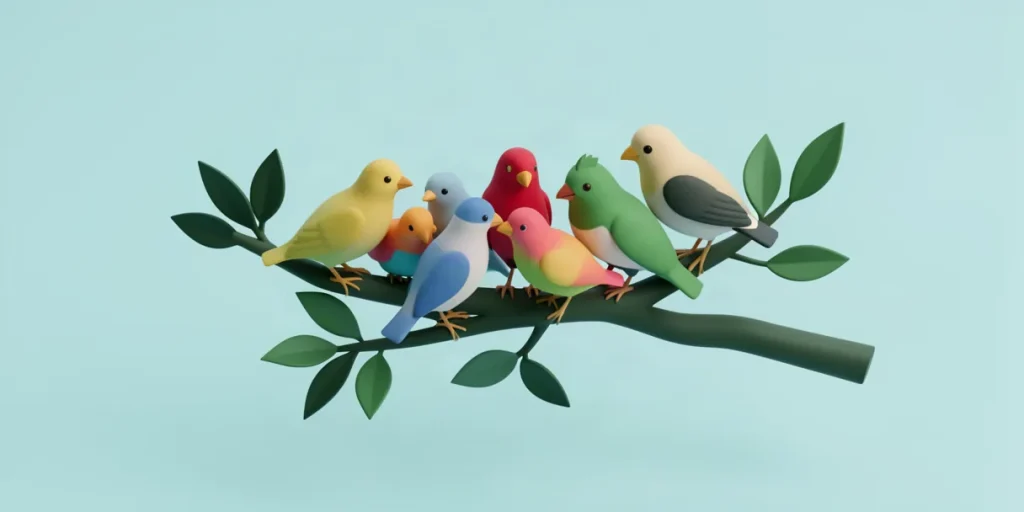
Pet birds use a variety of vocal and visual signals to communicate, forming complex social bonds within their flock. Their communication plays a crucial role in establishing and maintaining hierarchies, interacting with peers, and adapting to their environment.
Understanding the features of communication and social bonds in pet birds is important not only for their successful care but also for enhancing their well-being and health. Interactions between birds can include singing, calls, gestures, and even behavioral rituals that promote social cohesion and reduce conflicts.
Studying these aspects helps owners and professionals create conditions as close as possible to the birds’ natural habitat, positively affecting their mental and physical state. This article examines the main communication mechanisms and types of social bonds typical for various species of pet birds.
| Bird Species | Type of Communication | Optimal Group Size | Special Requirements |
|---|---|---|---|
| Budgerigar | Sounds, postures, tactile contacts | 5–15 individuals | Requires at least 0.5 m² of space per bird |
| Domestic Pigeon | Pair bonds, visual signals | Pairs lasting 2–3 years | Pair stability is important for well-being |
| Canary | Singing, visual signals | 1–3 individuals | Does not tolerate large groups well, sensitive to stress |
| Cockatiel | Calls, crest raising | 3–7 individuals | Needs regular socialization and toys for stimulation |
- 0.5 m² minimum cage area per bird
- 2–3 years average duration of pair bonds in domestic pigeons
- 1200 ₽ price of the Trixie “Bird World” toy for stimulating communication
- 15% increase in food consumption by birds living in groups
- 40% chance of conflicts when new birds are introduced improperly
What Types of Communication Do Pet Birds Use?
Vocal Communication
Pet birds actively use a variety of vocal signals to communicate and coordinate within the flock. For example, budgerigars can produce up to 10 different types of calls and whistles, helping them maintain contact and warn of potential danger. Vocal signals can convey information about location, emotional state, and intentions. In a home environment, these sounds remain important, aiding birds’ adaptation and strengthening social bonds.
Visual and Tactile Communication
Visual signals in pet birds include body postures and movements, such as crest raising in cockatiels, which signals excitement or anxiety. These gestures help birds quickly exchange information silently. Tactile contact also plays a vital role in communication: canaries, for example, engage in mutual preening to strengthen social ties and reduce stress. Physical contact fosters trust and harmony within the group.
- Budgerigars produce up to 10 types of vocal signals
- Crest raising in cockatiels indicates emotional arousal
- Preening among canaries reduces stress and strengthens bonds
How Are Social Groups Formed in Pet Birds and Why Is It Important?
Social groups in pet birds form through stable pair bonds and group living, which provides behavioral stability, reduces stress, and improves physiological indicators. For example, domestic pigeons form pairs that last on average 2–3 years, reinforcing social structure and supporting reproduction.
Pair Bonds
Domestic pigeons form long-term pairs averaging 2–3 years, providing a reliable foundation for social and reproductive stability. These pairs help coordinate care of offspring and defend territory, reducing internal conflicts. Such stable pair bonds are important for maintaining order in the colony and successfully raising chicks.
Flock Lifestyle
Budgerigars live in flocks of 5 to 15 individuals, which reduces anxious behavior by about 30%. Group living promotes metabolic normalization: birds in company become more active and increase food intake by roughly 15%, positively affecting their health and immunity. The flock provides protection from predators and improves communication among birds.
- Average pair bond duration in domestic pigeons – 2–3 years
- Budgerigar flock size – 5 to 15 individuals
- Reduction of anxiety in groups – approximately 30%
- Increase in activity and food consumption in groups – about 15%
How Can Pet Bird Care Be Improved Considering Their Social Needs?
Space and Equipment
To improve pet bird care with respect to their social needs, each bird should be provided with at least 0.5 m² of space, meeting the European Association of Aviculture 2026 standard and helping prevent conflicts within groups. It is important to purchase specialized toys, such as the Trixie “Bird World” model costing around 1200 ₽, which encourage active communication and mental stimulation. Mirrors also support social interaction, especially for birds kept alone.
- Minimum space per bird – 0.5 m² (European Association of Aviculture, 2026)
- Trixie “Bird World” toy – about 1200 ₽
- Use of mirrors to stimulate interaction
Daily Routine
Organizing daily shared time among birds significantly strengthens social bonds and reduces stress levels. It is recommended to allocate at least 1 hour a day for interaction in a communal cage or a specially equipped play area. Regular joint activities help birds adapt to the group and develop communication skills, positively affecting their overall condition and behavior.
- Daily shared time – at least 1 hour
- Use of play areas for social activity
What Common Mistakes Do Owners Make When Organizing Social Bonds in Birds?
Keeping Birds Alone
A frequent mistake among pet bird owners is keeping birds alone, especially budgerigars, which leads to depression and reduces lifespan by around 20%. According to 2025 research from the Ornithology Institute, solitary keeping disrupts birds’ natural social needs, causing stress and behavioral problems. To prevent this, budgerigars should be kept at least in pairs or small groups.
Overcrowding
Another common mistake is overcrowding the cage: exceeding two birds per 0.5 m² leads to increased aggression and conflicts within the group. Studies from the Ornithology Institute 2025 confirm that such density causes significant stress and injuries. Additionally, lack of an adaptation period when introducing new birds into an existing group raises the risk of conflicts and injuries with probabilities up to 40%.
- No more than 2 birds per 0.5 m² cage – optimal density to prevent aggression;
- Mandatory adaptation period when introducing new birds – at least 14 days;
- Keeping budgerigars preferably in pairs or small groups to maintain mental health.
What Limitations Exist in Pet Bird Communication and When Do Social Bonds Fail?
Pet bird communication is limited by species-specific traits, health status, and stress levels, which can weaken or completely disrupt social bonds. For example, canaries poorly tolerate groups larger than three individuals, and respiratory diseases lead to loss of vocal activity, worsening mutual understanding among birds.
Species-Specific Traits
Canaries show low social tolerance: housing more than three birds in one cage causes tension and reduces communication activity. Unlike budgerigars, which can maintain social bonds in groups up to 10 individuals, canaries tend to isolate themselves. This limitation is linked to their natural behavior and vocalization ability, which decreases with overcrowding.
Health and Stress
Respiratory problems cause birds to stop making sounds, signaling the need for veterinary care. Furthermore, sudden temperature fluctuations over 5°C per day reduce pet birds’ communicative activity by about 25%. Strong stress from adverse conditions significantly weakens social bonds and may lead to aggression or apathy.
- Maximum comfortable number of canaries per group – no more than 3 individuals
- Temperature fluctuations over 5°C daily reduce communication by 25%
- Loss of vocalization is a sign of possible respiratory illness
Frequently Asked Questions
Why is it important to keep budgerigars in groups?
What is the recommended minimum cage size for one pet bird?
What should be done if birds show aggressive behavior in the same cage?
How can you tell if a bird is stressed due to social isolation?
Key Takeaways
- Vocal and visual communication are key ways pet birds interact.
- Social groups reduce stress and improve birds’ quality of life.
- Minimum cage space is 0.5 m² per bird according to 2026 standards.
- Keeping birds alone or overcrowding leads to behavioral problems.
- Bird health directly affects their ability to communicate.