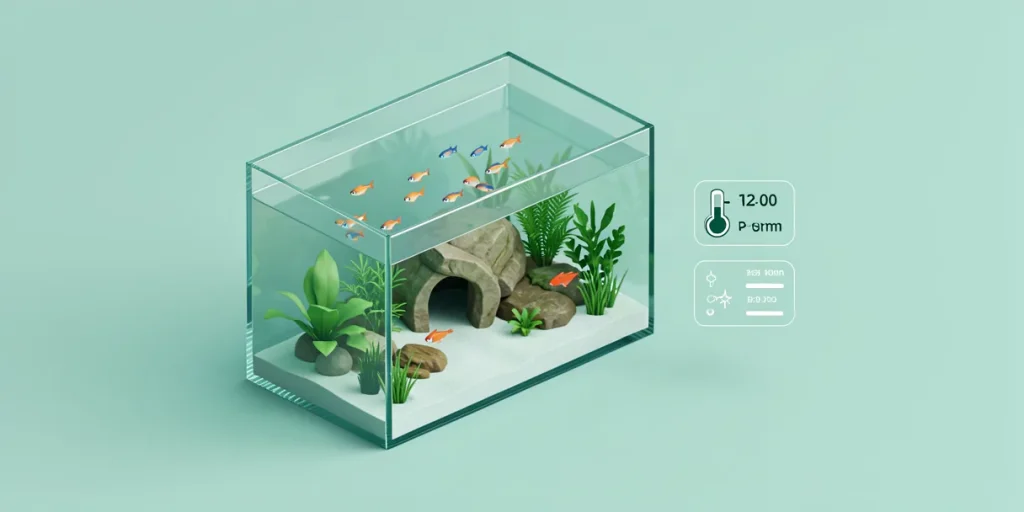
Choose aquarium fish based on the tank’s volume, temperature and compatibility: first determine what conditions you can maintain, then select fish that suit them.
Even hardy fish need suitable water and enough space, and peaceful cohabitation depends on the species and their needs. So when choosing fish, look beyond their appearance and consider how they will live together.
This article explains how to compare species and prepare suitable conditions so the aquarium’s inhabitants are a good fit for what the tank can support.
| Species or group | What to consider | Aquarium guideline |
|---|---|---|
| Goldfish | Potential length — 20 cm | Often recommended: 80 liters or more |
| Malawi cichlids | Consider keeping them in a group | 150–200 liters |
| Angelfish | Match their needs to the conditions and tankmates | 150–200 liters |
| Danios | Small, schooling fish that stay near the surface | Volume depends on the particular species and the tank’s other inhabitants |
- 24–26 degrees Optimal water temperature
- 10–25 Water hardness
- 7–8,5 Water acidity
- 20 cm Potential length of a goldfish
- from 80 liters Commonly recommended aquarium volume for a goldfish
How do you determine which fish can live in your aquarium?
To determine which fish can live in your aquarium, consider its volume, the fish’s adult size and the behavior of each species, then check their compatibility and water requirements.
Start by assessing the aquarium itself: how much water it holds and where it will be placed. Volume limits your options more than fish coloration does. Consider not only how large the fish are now, but how large they will grow.
Make a list of species and compare them using specific criteria:
- Adult size: Will the fish be able to live in the chosen aquarium once fully grown?
- Temperament: Will any of the inhabitants chase or injure the others?
- Social needs: Does the species need to be kept in a school, and is there room for one?
- Water requirements: Are the conditions the fish need compatible?
The fact that different species are sold in the same store does not mean they are compatible. Check each species’ requirements separately and consider whether the fish can live together in the same aquarium.
Hold off on buying fish until you know how the chosen species will get along and what the aquarium will be like once they are fully grown.
How do you check the water before buying fish?
Before buying fish, check the water temperature, hardness and acidity, and compare the results with the requirements of all the species you have chosen. The parameters must suit all the aquarium’s inhabitants, not just one species.
As a general guideline, 4lapy.ru gives these values: optimal water temperature — 24–26 degrees, hardness — 10–25, acidity — 7–8,5. This is a guideline, not a universal standard: the requirements of individual species may differ.
- Temperature: Measure it with an aquarium thermometer and compare it with the needs of your chosen fish.
- Hardness and acidity: Find out which tests are used to check these parameters and what values each species needs.
- Adjustments: Before adding fish, find out how each parameter can be changed and how to monitor the results.
If the species have conflicting requirements, choose fish that can be kept under compatible conditions. General guidelines do not replace checking the needs of each species.
How do you choose an aquarium size for adult fish?
Choose an aquarium based on the adult size and needs of the fish, not on how they look in the store: a goldfish can grow to 20 cm, and an aquarium of 80 liters or more is often recommended for it.
A goldfish needs room to swim freely. For schools of Malawi cichlids or angelfish, consider an aquarium with a volume of 150–200 liters.
- Goldfish: A guideline is an aquarium of 80 liters or more, taking adult size into account.
- A school of Malawi cichlids or angelfish: Consider a volume of 150–200 liters.
- 30-, 60- and 200-liter aquariums: These are guidelines for different tank sizes, but volume alone does not show how many fish you can keep.
The appropriate number of fish depends on more than tank volume: consider the adult size of the species you choose and whether they will have room to move freely. Before buying, check that the chosen volume is suitable for adult fish in particular.
How do you stock an aquarium without adding too many fish?
To stock an aquarium successfully, prepare it first and check that the water suits the fish you have chosen. Then assess the compatibility of all the species and the needs of the adult fish.
Make a list of the aquarium’s inhabitants before buying them. For each pair of species, check their behavior and which part of the water they occupy: some fish stay near the surface, while others live in the middle or near the bottom. Having these needs in common does not, by itself, guarantee compatibility, so consider both criteria.
- Water parameters: Do not move fish into the aquarium until you have checked that the conditions suit them.
- Compatibility: Assess each species’ behavior and how well it gets along with the other inhabitants.
- Number of fish: Consider adult size and the needs of the particular species, not just the aquarium’s volume.
After adding the fish, monitor their behavior and the water parameters. If anything changes, do not add more inhabitants until you have found out why.
Which fish suit different conditions?
When choosing fish for an aquarium, consider more than their appearance: take into account their behavior, the requirements of the particular species and compatibility with tankmates.
- Danios are small, active fish that school near the surface. Choose their tankmates with this behavior in mind.
- Barbs are a diverse group, and their needs depend on the particular species. Find out what those needs are before buying rather than relying on the family name alone.
- Bristlenose plecos are sucker-mouth catfish. Check that the conditions in your chosen aquarium and its other inhabitants are suitable for them.
- Oscars may appeal to cichlid enthusiasts. Before choosing them, compare their needs with the aquarium’s volume and its other inhabitants.
For each species, check its compatibility with the fish already in the aquarium and its care requirements.
When might your choice of fish not work out?
Your choice of fish may not work out if the aquarium size, temperature or group composition is unsuitable for the species.
- Goldfish. Do not put one in a small aquarium just because it is small now: when choosing, consider its potential length and the recommended water volume.
- Temperature. General temperature guidelines do not replace the requirements of a particular species. Check what temperature it needs before buying.
- Schooling species. Do not stock an aquarium with just one fish of each species: find out in advance how many fish the species needs to live with and what aquarium volume is suitable for them.
- Compatibility. If information about care conditions or tankmates is conflicting, check the requirements for the particular species with the seller and compare them with a specialist species profile before buying.
Frequently asked questions
Which fish should I choose for a small aquarium?
Can I keep a goldfish in a small aquarium?
What temperature is suitable for aquarium fish?
Which fish can live in a 150–200-liter aquarium?
Sources
- aquael.ru — “How many fish should you keep in an aquarium? 30, 60, 200 liters. — Aquael”
- 4lapy.ru — “Care and keeping of aquarium fish — read the Four Paws blog”