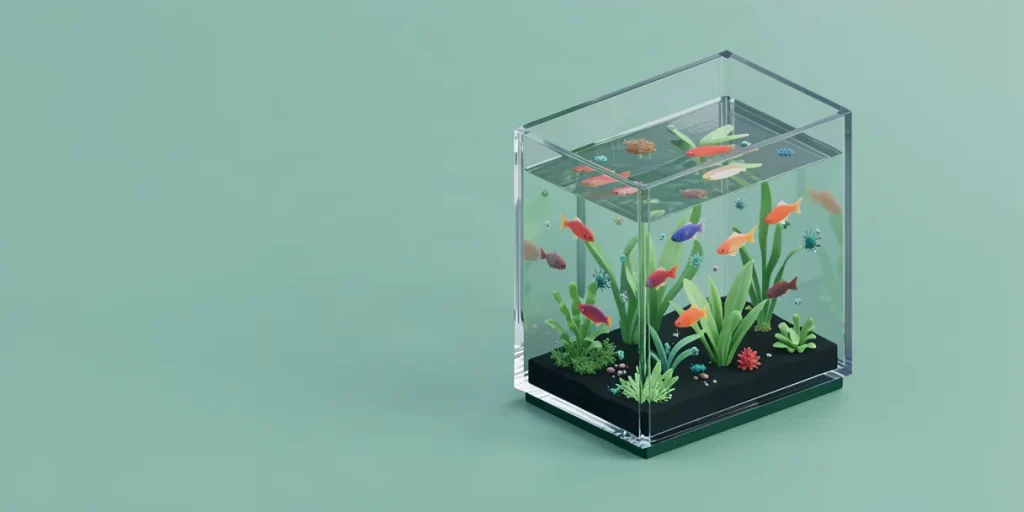
What Is Biological Balance in an Aquarium and Why Is It Important?
Biological balance in an aquarium is a stable ecosystem state where microorganisms, plants, and animals interact so that water quality stays optimal and fish and other inhabitants remain healthy. This balance is the key to long-term water clarity and disease prevention.
To maintain this balance, it is important to monitor ammonia (NH3) concentration in the water—it should be below 0.02 mg/l, as even small excesses cause toxicity. According to the Aquatic Life Water Quality Criteria (2026), keeping nitrites (NO2-) under 0.1 mg/l and nitrates (NO3-) below 20 mg/l is considered safe for most freshwater fish.
What Role Do Microorganisms Play in Aquarium Bio-Balance?
Microorganisms, especially bacteria, act as the main «filters» in an aquarium. They break down ammonia and nitrites, converting them into less harmful nitrates. This process, called nitrification, occurs in the biological filter and substrate.
Main Types of Bacteria and Their Functions
- Nitrosomonas – oxidize ammonia into nitrites.
- Nitrobacter – convert nitrites into nitrates.
Without a sufficient colony of these bacteria, toxic compound levels quickly rise, causing stress and death among fish. To speed up filter colonization, products with live bacteria, like Tetra SafeStart (around 700 rubles for 100 ml), are recommended and can be added right after setting up the aquarium.
How Do Plants Affect Biological Balance?
Aquarium plants absorb nitrates and other dissolved substances, lowering their concentration in the water and reducing the risk of algae blooms. With proper lighting and nutrition, plants actively participate in oxygen and carbon dioxide exchange, improving the environment’s quality.
Best Plants to Support Balance
- Amazon Sword (Echinodorus amazonicus) – efficiently absorbs nitrates and adapts easily.
- Anubias nana – an undemanding plant resistant to various conditions.
- Cabomba – a fast-growing aquatic grass that cleans water well.
Plants require regular fertilization and lighting—the optimal light regime is 8-10 hours daily with about 0.5 W/l of water. Aquael Leddy Smart 15 W LED lamps cost around 1200 rubles and provide a suitable light spectrum.
How to Choose and Care for Fish to Maintain Balance?
Fish selection affects the aquarium’s biological load. Overcrowding increases waste, causing ammonia and nitrite spikes that disrupt the balance. It is recommended to follow the guideline of 1 cm of fish length per 1 liter of water.
Fish Species Suitable for a Balanced Aquarium
- Neon Tetras – hardy and produce a moderate amount of waste.
- Guppies – resilient to various conditions and compatible with plants.
- Ancistrus catfish – help control algae growth.
Fish require feeding 1-2 times a day, avoiding overfeeding which pollutes the water. TetraMin Tropical Flakes, costing 350 rubles per 100 g, are suitable for most tropical species.
Common Mistakes That Hinder Bio-Balance
Typical aquarium care errors include irregular water changes, overfeeding, improper lighting, and ignoring proper aquarium startup procedures (cycling).
List of Typical Mistakes
- Water changes that are too frequent or too rare (optimal is 15-20% weekly).
- Overcrowding and disproportionate aquarium volume.
- Using untreated or unverified water.
- Insufficient time for biofilter startup (cycling takes 4-6 weeks).
Breaking these rules leads to ammonia and nitrite spikes, harming fish health and causing water cloudiness.
| Parameter | Optimal Level | When Balance Is Disrupted |
|---|---|---|
| Ammonia (NH3), mg/l | <0.02 | >0.05 |
| Nitrites (NO2-), mg/l | <0.1 | >0.5 |
| Nitrates (NO3-), mg/l | <20 | >50 |
| Water Clarity, % light | 85–95% | <60% |
- 4-6 weeks – aquarium cycling period for biofiltration startup
- 15-20% – recommended weekly water change volume
- 0.02 mg/l – maximum allowable ammonia level
- 700 ₽ – price of bacterial startup product
Frequently Asked Questions
How can I tell if the bio-balance is disrupted?
Can chemical filters replace biological ones?
How often should I clean the substrate and filter?
Is it okay to start an aquarium with many fish at once?
Which plants are better to avoid for bio-balance?
Key Takeaways
- Maintaining ammonia below 0.02 mg/l and nitrites below 0.1 mg/l is critical for fish health.
- Live bacteria Nitrosomonas and Nitrobacter provide biological filtration and should develop in filters and substrate.
- Active use of plants such as Amazon swords and anubias helps reduce nitrates and improves water quality.
- Choosing fish properly and following the 1 cm fish per 1 liter water rule prevents overcrowding.
- Regular 15-20% weekly water changes and careful filter maintenance keep the ecosystem stable.
In summary, biological balance in a home aquarium is a carefully balanced system requiring an understanding of the roles of microorganisms, plants, and fish. Following basic rules for startup, care, and water parameter control will keep your aquarium clear and healthy for years without costly interventions.