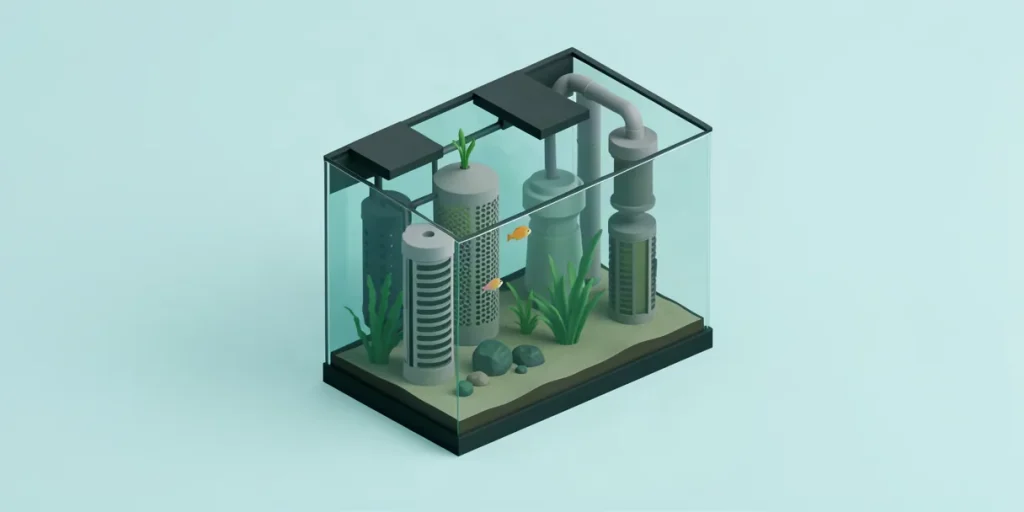
Biofilters for aquariums provide natural water purification through colonies of beneficial bacteria, but different technologies have their own advantages and drawbacks that affect efficiency, maintenance, and cost. Choosing the right biofilter depends on the aquarium’s volume, water composition, and maintenance requirements.
Aquarium owners need to understand how various types of biofilters work to ensure a healthy environment for fish and plants. This article reviews key biofiltration technologies — from sponge and canister filters to modern modular systems with bio-ceramics and honeycomb elements. An analysis of pros and cons will help select the optimal solution for specific conditions and budget.
Modern biofilters play a crucial role in maintaining the balance of the aquarium ecosystem, impacting water quality and pet health. Let’s examine how different filtration technologies perform in practice, which require minimal upkeep, and which offer maximum biological activity. This will enable an informed choice and improve aquarium care in 2026.
| Model | Flow Rate (l/h) | Recommended Volume (l) | Price (₽) |
|---|---|---|---|
| Fluval FX6 | 1500 | up to 600 | around 12000 |
| JBL CristalProfi i80 | 800 | up to 80 | around 5000 |
| Aquael Turbo Filter 500 | 500 | up to 60 | around 1500 |
| AquaClear Biomax (media) | — | — | 1200 per 500 g |
- 1500 l/h flow rate of the Fluval FX6 filter
- 0.02 mg/l safe ammonia level with biofiltration
- 1200 ₽ price for a 500 g pack of AquaClear Biomax
How Do Different Types of Aquarium Biological Filters Work?
Various types of biological aquarium filters clean water through bacteria colonies but differ in design and surface area for biofiltration. Sponge filters like the Aquael Turbo Filter 500 combine mechanical and biological filtration with a flow rate up to 500 l/h, while filters using bio-ceramic media, such as AquaClear Biomax, provide up to 5000 m² of surface area per liter of material, greatly enhancing cleaning efficiency.
Operating Mechanism
Sponge filters work by passing water through porous material that traps large particles and serves as a substrate for beneficial bacteria growth. The Aquael Turbo Filter 500 simultaneously performs mechanical filtration and biological processes, purifying water from suspended solids and toxins. Filters with bio-ceramics channel water through specially designed ceramic rings with high porosity and large surface area. This promotes intensive growth of nitrifying bacteria, speeding up ammonia and nitrite breakdown.
Role of Filter Media
- Sponge media provides up to 95% mechanical filtration; prices for such filters start from 800 ₽;
- AquaClear Biomax bio-ceramic media create up to 5000 m² surface area per liter, costing about 1500 ₽ per set;
- Porosity and surface area determine biofiltration effectiveness and rate of harmful substance decomposition;
- Filter flow rate — the Aquael Turbo Filter 500 reaches 500 l/h, suitable for aquariums up to 100 liters.
What Is the Biofiltration Efficiency of Popular Filter Models in 2026?
Performance
In 2026, the biofiltration efficiency of popular filter models is primarily determined by their water throughput per hour. The external Fluval FX6 filter demonstrates high performance — up to 1500 liters per hour, delivering powerful biological water purification thanks to a large volume of filter media and advanced aeration system. Internal filters like the JBL CristalProfi i80 have a lower flow rate of about 800 liters per hour, matching their compact size and smaller volume. Flow rate directly affects the speed and quality of biofiltration, especially in aquariums with high biological load.
Recommended Aquarium Volume
The recommended aquarium volume for effective biofilter operation depends on the model and stated flow rate. The Fluval FX6 suits aquariums up to 600 liters, making it an optimal choice for large and medium tanks with diverse inhabitants. The internal JBL CristalProfi i80 targets aquariums up to 80 liters, limiting its use to small and medium tanks. Considering these parameters is essential to ensure maximum biofiltration efficiency.
- Fluval FX6: flow rate 1500 l/h, aquarium up to 600 l
- JBL CristalProfi i80: flow rate 800 l/h, aquarium up to 80 l
How Does the Type of Biofilter Affect Fish Health and Water Quality?
Ammonia Control
The biofilter type directly impacts ammonia levels in aquarium water, which is critical for fish health. Bio-ceramic media, for instance in AquaBioCeram filters (2026), can reduce ammonia concentration to a safe level of 0.02 mg/l, as confirmed by studies from the Aquarium Science Institute in 2025. Sponge filters, due to smaller bioactive surface area, typically maintain higher ammonia levels and require more frequent cleaning to prevent toxicity.
Maintenance Frequency
Sponge biofilters need cleaning at least once every 7 days to avoid buildup of harmful substances and water quality deterioration. In contrast, bio-ceramic filters with coarse media last longer without intervention, reducing maintenance time and stress for pets. Average prices for bio-ceramic filters on the market in 2026 range from 3500 to 6000 ₽, while budget sponge models are available for 800–1500 ₽.
- AquaBioCeram bio-ceramic filter: ammonia ≤ 0.02 mg/l;
- Sponge filter: cleaning every 7 days;
- Bio-ceramic filter cost: 3500–6000 ₽;
- Sponge filter cost: 800–1500 ₽.
What Maintenance Features and Costs Are Associated with Different Biofilters?
Maintenance Costs
Biofilter upkeep involves regular replacement of media and consumables, with costs varying significantly by filter type and brand. For example, replacement media AquaClear Biomax costs about 1200 ₽ for a 500 g pack, sufficient for 2-3 months of use. Internal filters with smaller media volume require more frequent replacement, increasing overall expenses.
Energy Consumption
Energy efficiency of biofilters directly affects monthly electricity bills. The external Fluval FX6 consumes about 18 W, which, running 24 hours daily, results in noticeable costs. Meanwhile, the internal JBL CristalProfi i80 uses only 10 W, significantly reducing electricity expenses. Choosing a filter with optimal power consumption helps balance operating costs while maintaining filtration quality.
- Replacement media AquaClear Biomax — about 1200 ₽ per 500 g;
- Media lifespan — 2-3 months for medium volumes;
- Power consumption of Fluval FX6 — 18 W;
- Power consumption of JBL CristalProfi i80 — 10 W;
- Energy consumption directly impacts monthly electricity bills.
When Can Biofiltration Fail to Clean Aquarium Water?
Overcrowding
Biofiltration becomes ineffective with aquarium overcrowding when there is more than one fish per 4 liters of water. At this load, ammonia and nitrite levels rise, and the biofilter cannot neutralize them fast enough, leading to water quality decline and increased risk of diseases. For example, in an 80-liter tank with over 20 fish, biofiltration will start to fail.
Incorrect Volume
Selecting a filter matching aquarium volume is critical. Installing a JBL CristalProfi i80 internal filter, designed for up to 80 liters, in a 200-liter tank drastically reduces filtration effectiveness. Such a filter cannot provide necessary water turnover and biological load, causing toxin buildup and worsening fish conditions. The ideal filter should equal or exceed the aquarium’s volume by at least 1.5–2 times.
- Overcrowding: more than 1 fish per 4 liters lowers biofiltration efficiency.
- JBL CristalProfi i80 is for aquariums up to 80 liters and unsuitable for 200-liter tanks.
- Recommended filter volume — at least 1.5–2 times the aquarium volume for stable operation.
Frequently Asked Questions
How often should a biofilter be cleaned in an aquarium?
Can a biofilter be used without mechanical filtration?
How to choose a biofilter for a 100-liter aquarium?
Which biofilters are suitable for tropical fish with sensitive skin?
Key Takeaways
- Bio-ceramic media offer up to 5000 m²/l surface area for bacteria.
- The Fluval FX6 filters up to 1500 l/h — suitable for aquariums up to 600 l.
- Sponge filters require cleaning at least once a week.
- AquaClear Biomax media costs about 1200 ₽ per 500 g.
- Aquarium overcrowding reduces biofiltration effectiveness.