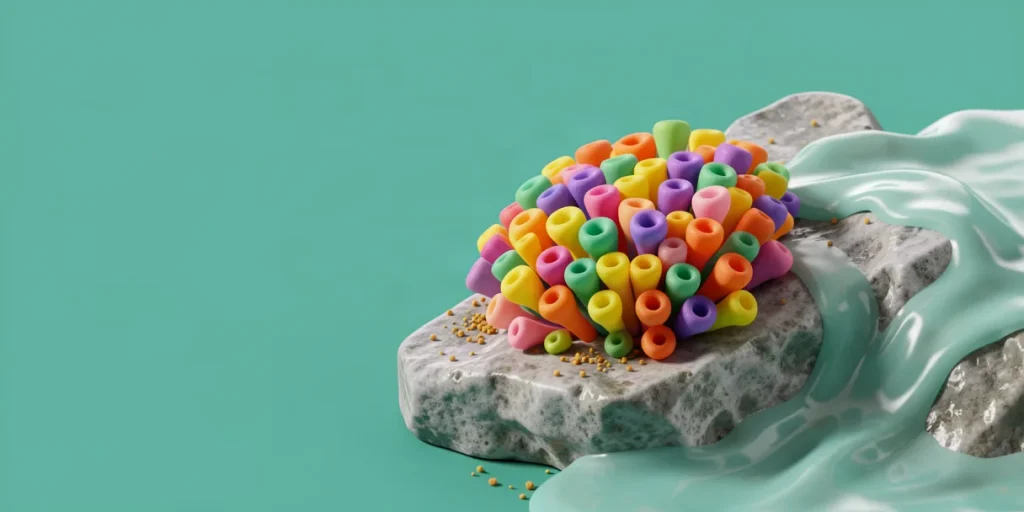
Zoanthids need stable saltwater, moderate lighting, and small supplementary feedings. Start with gentle conditions and observe how the colony responds.
These brightly colored corals may look undemanding, but changes in lighting and water quality affect their condition. In this guide to zoanthids in the aquarium, we’ll look at how to choose lighting, maintain suitable conditions, and tell whether the colony needs extra food.
| Option | Role | What to watch for |
|---|---|---|
| Zooxanthellae | Provide some of their nutrition | Do not replace monitoring the colony’s condition |
| Zooplankton | Supplementary food | Watch whether it is eaten and check for leftovers |
| Finely chopped shrimp, mussels, and marine fish | Varied supplementary food | Do not leave uneaten pieces |
| Light | Supports nutrition through zooxanthellae | Do not make sudden changes alongside other conditions |
| Filtration | Helps control water quality | Monitor nitrates and phosphates |
What Do Zoanthids Eat in a Home Marine Aquarium?
Symbiosis and Supplementary Food
Zoanthids get some of their energy from symbiotic zooxanthellae, so they can live in an aquarium without targeted feeding. To support growth and color, offer them supplementary food regularly and observe how the colony responds.
Suitable foods include zooplankton and finely chopped meat from marine animals. These options differ in origin, but both provide polyps with food in addition to what they get through symbiosis:
- Zooplankton — the main animal-based food option for zoanthids.
- Shrimp, mussel, and marine fish meat — chop it finely to offer in small pieces.
For good growth, offer food daily and assess the colony’s response: whether the polyps accept the food and retain their usual appearance. At the same time, monitor water quality and filtration: excess phosphates and nitrates are undesirable, as they may be associated with a decline in polyp numbers and the colony dissolving.
How Can You Feed the Colony Without Compromising Water Quality?
Offer zoanthids small portions of zooplankton or finely chopped shrimp, mussel, and marine fish meat, and remove any uneaten food so it does not add to the water’s organic load. Base the amount on what the colony actually eats, not on a one-size-fits-all dose set in advance.
Suitable food for zoanthids should be small: chop larger pieces of shrimp, mussel, or fish so the polyps can take them more easily. Zooplankton is also suitable for regular feeding; feeding frequently is no reason to leave food in the aquarium. Remove any food left uneaten.
Filtration and the Colony’s Condition
Zoanthids need powerful filtration to control nitrates and phosphates: high concentrations of these compounds can be associated with a decline in polyp numbers and colony size. So adjust the amount of food based on two observable signs—whether it is eaten and the condition of the water—not on a fixed quota.
What Roles Do Light and Water Flow Play?
Light provides zoanthids with some of their nutrition through zooxanthellae living in their tissues, while plankton is a separate dietary supplement. Lighting and targeted plankton feeding therefore serve different purposes: one supports symbiosis, and the other delivers food to the polyps.
Closed polyps alone do not show that the light is too bright: the response may also be related to other changes in conditions. If you change the lighting, watch how the polyps open and monitor the colony’s color; do not change the light, feeding, and filtration all at once—it will be easier to determine what caused the change.
Water Flow and Feeding
The water flow should carry small food particles to the polyps, not sweep them away from the colony immediately. When target-feeding, direct small portions of food toward the zoanthids rather than dispersing it throughout the aquarium. This keeps feeding focused instead of turning it into uncontrolled food input.
Which Water Parameters Should You Check Alongside Feeding?
Test First, Then Make Adjustments
Along with feeding zoanthids, monitor nitrates, phosphates, and the basic parameters of the saltwater: high nitrate and phosphate concentrations have been linked to declining polyp numbers and dissolving colonies. Keep this in mind when adding supplementary food, too: test the water rather than judging only by the appearance of the polyps.
For a marine aquarium, moscorals.ru gives the following reference ranges; units of measurement are not specified:
- Calcium: 400–470.
- Magnesium: 1300–1400.
- KH: 7–8,5.
- pH: 8,1–8,4.
Compare test results with the requirements of your particular system and adjust the parameters to suit its specific characteristics.
Purifying Water After Reverse Osmosis
In the setup described by moscorals.ru, two canisters containing deionizing resin are installed in sequence after the reverse-osmosis stage. Examples given include Tulsion MB-115 by Thermax Ltd (India) and Purolite Virgin MB478 (Romania); check that the resin is suitable for your system before using it.
When Won’t Supplementary Feeding or a Change in Lighting Help?
Supplementary feeding or a change in lighting will not help if the zoanthid colony is shrinking because of problems with water quality or filtration, or conditions unsuitable for that particular species. Extra food alone will not correct a possible excess of nitrates or phosphates: if the colony’s condition worsens, check the filtration and water parameters first rather than increasing the portion.
A temperature range given for one zoanthid cannot automatically be applied to all colonies. For example, descriptions mention a range of 21–30 °C, while species from temperate latitudes may overwinter at 16–18 °C. This is not a universal recommendation, so conditions should be matched to the origins of the particular species.
How to Avoid Misdiagnosis
Do not make a sudden change to the lighting just to test the polyps’ response: their closing after a change does not prove that light intensity is to blame. Change conditions gradually and observe the colony without introducing new supplementary food at the same time; this makes it easier to determine which change is linked to improvement or deterioration.
Do not apply the calcium, magnesium, KH, and pH figures to your aquarium without checking the units and whether the tests are compatible. Check exactly what the test measures and which units it uses to report results; take the water in your particular system into account. If the colony continues to dissolve, do not try to compensate with food or a random change to one parameter.
Key Takeaways
- Zooxanthellae provide zoanthids with some of their nutrition, but supplementary food is used to support growth and color.
- Suitable foods include zooplankton and finely chopped shrimp, mussels, or marine fish.
- Daily feeding requires monitoring leftovers, nitrates, phosphates, and filtration.
- Assess lighting, feeding, and water quality separately; changing several conditions abruptly at once makes it harder to identify the cause of a response.
- Reference values for marine water include calcium at 400–470 and pH at 8,1–8,4, but check the units separately.
Frequently Asked Questions
Do zoanthids need to be fed every day?
Can zoanthids live without targeted feeding?
When feeding zoanthids, which is more dangerous: too little food or too much?
What water reference values are given for a marine aquarium?
Sources
- Zoasfan.ru — “Zoanthid Care Basics — Care — Zoanthids”
- aquamir-rostov.ru — “Aquarium World — Zoanthid — Button Polyp (Red, Fluorescent)”
- forum.zoasfan.ru — “Most Popular Content — Forums”
- reefcentral.ru — “What Do You Feed Zoanthids? — Newcomer Questions”
- reefcentral.ru — “Feeding Zoanthids — Corals”