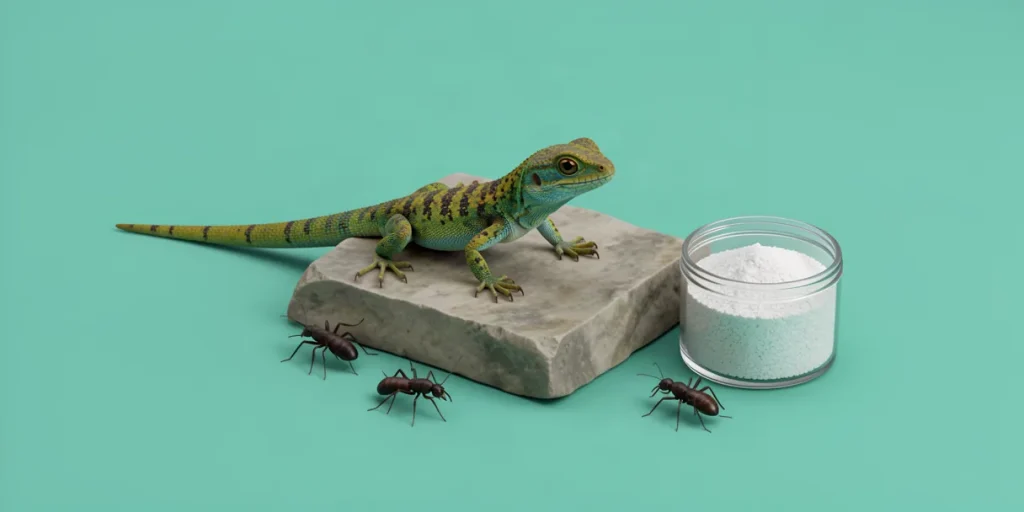
Sand lizards are fed live insects, with calcium and vitamin supplements added to their diet. Suitable food types and how often to use supplement powder depend on the animal’s age and condition.
Crickets, roaches, and other feeder insects should be an appropriate size: prey that is too large can make feeding difficult. It is also important to consider what the insects were fed before offering them to the lizard.
This article looks at which insects are suitable for sand lizards and how to use supplements without letting them replace a varied diet.
| Feeder prey | Role in the diet | Practical consideration |
|---|---|---|
| Insects | Diet staple | Rotate different types |
| Insect larvae | One type of feeder prey | Do not make them the only prey |
| Beetles and butterflies | Options for variety | Watch to see whether the lizard can manage them |
| Snails | An additional feeder option | Offer prey of a suitable size |
- 25–27 см length of the sand lizard
- 2.6 г daily food intake in the studied population during a particular period
- 2.2 г daily food intake in August
What should you feed a sand lizard?
Feed a sand lizard live insects: it is an insectivorous predator, and insects make up the bulk of its diet.
Suitable prey includes different insects and their life stages: larvae, beetles, and butterflies. Snails can also be included in the menu.
- Insects — the staple food for sand lizards.
- Larvae, beetles, and butterflies — suitable feeder prey.
- Snails — a possible part of the diet.
Do not automatically make earthworms the mainstay of the menu: they are mentioned as food for other reptile species, not as a staple for sand lizards. Use live prey rather than scraps found by chance.
How do you choose the right size feeder insect?
Choose feeder insects based on how the sand lizard responds: it should be able to catch and swallow its prey without difficulty.
Sand lizards grow no longer than 25–27 см. This gives you an idea of the reptile’s size, but it does not determine the right size of insect: observe the lizard while it eats.
- Suitable prey: the lizard catches and swallows it without difficulty.
- Prey that is too challenging: the lizard cannot manage it — remove the insect from the terrarium and offer more suitable feeder prey.
Rotate insects and larvae so the diet does not consist of just one type of food.
How can you vary the diet and add calcium?
Vary a sand lizard’s diet by rotating feeder insects, their larvae, beetles, butterflies, and snails; choose calcium and vitamin supplements separately, following the instructions or consulting a veterinary professional.
Sand lizards are insectivorous predators, so their diet is based on a variety of feeder prey. Rotating prey helps prevent feeding from being limited to a single kind of insect.
Calcium and vitamins do not replace variety
- Calcium supplement. Use it to supplement feeder insects. Choose the dose according to the instructions for the specific product or a veterinary professional’s advice.
- Vitamin supplement. Check the ingredients before use and ask a reptile specialist about the right schedule: vitamins should not be given by guesswork.
- Feeder prey. Rotate insects, larvae, beetles, butterflies, and snails rather than limiting feeding to one type of prey.
Even carefully chosen supplements cannot make a monotonous diet complete. If you change the supplement or how you use it, check the instructions and ask a specialist to confirm the appropriate dose.
How can you tell if the diet is unsuitable?
A sand lizard’s diet may be unsuitable if it refuses different insects, has trouble catching or swallowing prey, or shows a noticeable change in behavior: review its feeding routine and seek advice.
Refusing one type of insect does not, by itself, mean that the whole diet needs to change. But feeding only one type limits variety: sand lizards are insectivorous predators, so their diet should be based on different insects.
- Food refusal. Note which insects the lizard will not eat and whether it refuses different types repeatedly.
- Difficulty with prey. If the lizard cannot catch or swallow its food, do not substitute prey found outdoors at random: its identity and condition may be unknown, and its safety unverified.
- Behavioral changes. A noticeable change is a reason to discuss feeding with a specialist, not simply to add another type of food.
Add calcium and vitamins only after checking the dose. Supplements can also be harmful in excess; if you are unsure about the amount, seek advice first.
How should you account for seasonal changes in appetite?
Account for seasonal changes in appetite by noting how much food your particular sand lizard eats and how it is doing: observations of a population do not establish a feeding allowance for a captive animal.
In the studied population of sand lizards (Lacerta agilis), daily food intake during a particular period was 2.6 г. In August, it fell to 2.2 г. This describes a seasonal observation, not a target that every pet lizard should meet at home.
Assess appetite based on actual food intake and the animal’s condition, not just the calendar. If its appetite changes suddenly, discuss it with a specialist.
When is a standard feeding routine unsuitable?
A standard feeding routine is not suitable for a sick or weakened sand lizard, or one that refuses food: it needs to be assessed by a reptile veterinary professional, not given a larger portion or an extra dose of supplements.
Age matters too. Recommendations for juveniles and adults may differ, so take the lizard’s age into account when choosing a feeding routine.
Do not apply another reptile species’ diet to a sand lizard. For example, earthworms are mentioned as food for slowworms, but that does not make them essential food for sand lizards.
If you are unsure about the species’ identification or an appropriate feeding routine, confirm both with a reptile veterinary professional.
Frequently asked questions
Can you feed a sand lizard just one type of insect?
Which insects are suitable as food?
Should you add calcium and vitamins?
How much food should you give in August?
Sources
- zoovet.ru — “Sand Lizard. — May 17, 2013 — Zoovet Forum”
- reptile.ru — “Feeding adult and juvenile sand lizards”
- 7dach.ru — “Lizards in the garden plot. Benefits and harms. Photos”
- lacerta.de — “Amphibians and reptiles of the Volga-Kama region”
- school-science.ru — “Comparative ecological and biological characteristics”