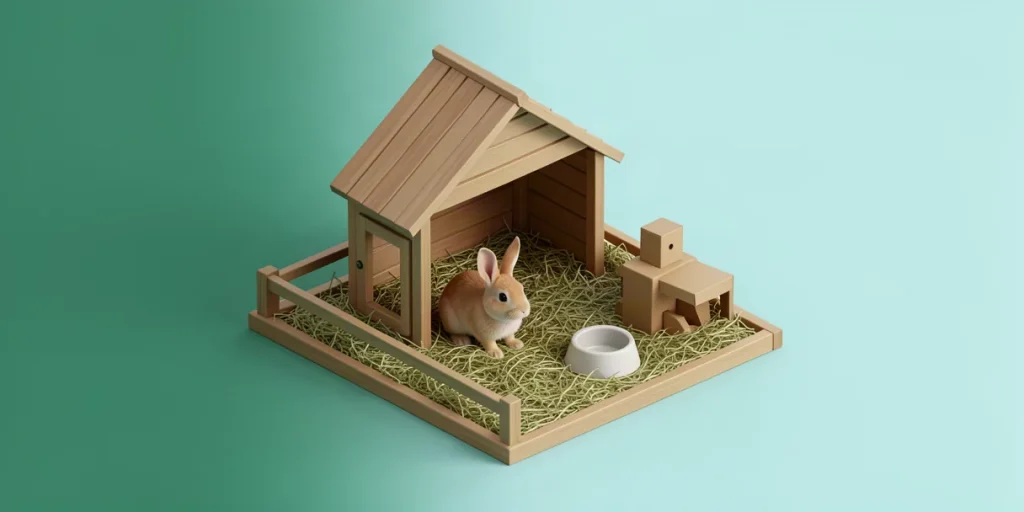
A dwarf rabbit can make a suitable pet if you’re prepared to provide a spacious, safe area, an appropriate diet, and regular care. It’s not a child’s toy, but an animal with daily needs.
When choosing a rabbit, consider more than its appearance and size: think about the conditions you can provide. Before buying one, consider where it will live, who will care for it, and whether veterinary care is available.
| Option | Suitable for | What to provide |
|---|---|---|
| Spacious cage | A dwarf rabbit weighing up to 1 kg or one that often runs outside its cage | A solid floor, room to move freely, and enough space to stand on its hind legs |
| Enclosure | A rabbit that needs more room to move around | A hideout, a toilet area, a water bottle, and a bowl |
| Free roaming | A rabbit in a safe room | Protection from drafts and direct sunlight, plus a separate quiet space |
- 45–50 g weight of kits at birth
- 2–2.5 kg weight of kits by 8–10 weeks
- 2.5–3 kg weight of kits by 12 weeks
- 5.1 kg average weight of White Giant rabbits
How can you avoid mistaking a large rabbit kit for a dwarf rabbit?
To avoid mistaking a large rabbit kit for a dwarf rabbit, don’t judge by size alone: ask about its breed and expected adult size.
Small size at a young age is no guarantee
A small rabbit kit can gain weight quickly, so its size when you buy it doesn’t show how large it will become. Kits weigh 45–50 g at birth, but reach 2–2.5 kg by 8–10 weeks and 2.5–3 kg by 12 weeks.
For comparison, White Giant rabbits weigh an average of 5.1 kg, ranging from 4.3 to 8.3 kg. This doesn’t mean that every large rabbit kit belongs to this breed: an adult rabbit’s size depends on its breed.
- Breed: Ask the seller what breed the rabbit kit is.
- Expected adult size: Find out how big the rabbit is likely to get.
- If the seller can’t answer: Don’t assume the rabbit will stay small.
What kind of housing should you prepare for a dwarf rabbit?
It’s best to prepare a spacious enclosure or a rabbit-proof room for free roaming; a cage can serve as a permanent home for a small pet or one that often spends time outside it.
Before letting your rabbit roam freely, check the room: it should have plenty of room to move around, and the space itself must be safe. If you choose a cage, consider not only its outside dimensions but also how your pet will be able to use the space inside.
- Solid floor. The rabbit should be able to move freely and stand on its hind legs without obstruction.
- Suitable location. Place the cage away from drafts and direct sunlight.
- Bedding. You can line the bottom with straw, hay, or aspen shavings.
A spacious cage can be a permanent home for a dwarf rabbit weighing up to 1 kg or for a pet that often runs outside it. In other cases, a spacious enclosure or free roaming gives the rabbit more room to move around.
What should you put in the cage, and how do you manage daily care?
Set up a separate toilet area in your dwarf rabbit’s cage, and add a hideaway, a water bottle, and a food bowl. Include chew toys and pieces of cardboard, and, if there’s enough room, a sandbox.
The cage should be spacious: it’s important for the rabbit to move freely and stand on its hind legs. Choose a spot away from drafts and direct sunlight, and line the floor with straw, hay, or aspen shavings.
- Toilet: Set aside a corner so the rabbit can use it without taking up its resting space.
- Hideout: Put in a little house where your pet can hide.
- Water and food: Secure a water bottle and provide a stable bowl.
- Things to do: Offer chew toys and cardboard; add a sandbox if it won’t get in the rabbit’s way.
Hay and water should always be available
Good-quality hay and fresh drinking water are the mainstays of a pet rabbit’s diet. Make sure the water bottle is full and hay is always within reach.
Dwarf rabbits groom themselves, so they don’t need regular baths. Bathe your pet only when there’s a specific reason to, and keep its ears dry.
Which handling and health issues need attention?
Issues to watch for when caring for a dwarf rabbit include punishing unwanted behavior, forcing interaction, and neglecting nail care. Your pet’s health should also be checked regularly by a veterinarian.
- Punishing behavior. Don’t scold your rabbit for doing something you dislike. First, try to find a possible reason: for example, consider whether the behavior is related to its living conditions or the way you handle it. Then adjust the conditions or how you interact with it.
- Unwanted handling. Don’t pick up your rabbit if it resists or tries to get away. Interact calmly and watch its reaction: if your pet avoids contact, give it space.
- Trimming nails in poor light. Make sure you have bright lighting before trimming. A blood vessel runs through each nail—you need to see it to avoid cutting it.
- Skipping checkups or ignoring changes in health. Schedule veterinary checkups. If your rabbit’s behavior or well-being changes, consult a veterinarian rather than assuming it’s simply a matter of temperament.
When might a cage and standard advice not be suitable?
A cage and general recommendations may not be suitable if your rabbit is cramped, free roaming isn’t safe in your home, or your pet can’t tolerate bathing. Choose the setup and approach to care based on its behavior and circumstances.
Your choice depends on the rabbit’s behavior and your home.
- Cage: It limits movement, so an active rabbit may be better suited to an enclosure or safe free roaming.
- Free roaming: It isn’t suitable for every home. Keep wires and other hazards out of reach, and set aside a quiet space for your pet.
- Cage location: Even a spacious cage shouldn’t be placed in direct sunlight or a draft.
If your rabbit can’t tolerate bathing, don’t bathe it unless necessary. If a specific problem arises, ask your veterinarian whether bathing is needed and how to do it.
Frequently Asked Questions
Can a dwarf rabbit live in a cage all the time?
What must a cage have?
Does a dwarf rabbit need a bath?
What should you feed a pet rabbit?
Sources
- alisavet.ru — “Keeping Rabbits at Home”
- vetpreparatdelta.ru — “What to Know Before Getting a Pet Rabbit”
- 4lapy.ru — “A Guide to Rabbits as Pets — Read on the Four Paws Blog”
- Zootovary.ua Blog — “Pet Rabbits: Care and Housing”
- vetsas.by — “Keeping a Pet Rabbit at Home”