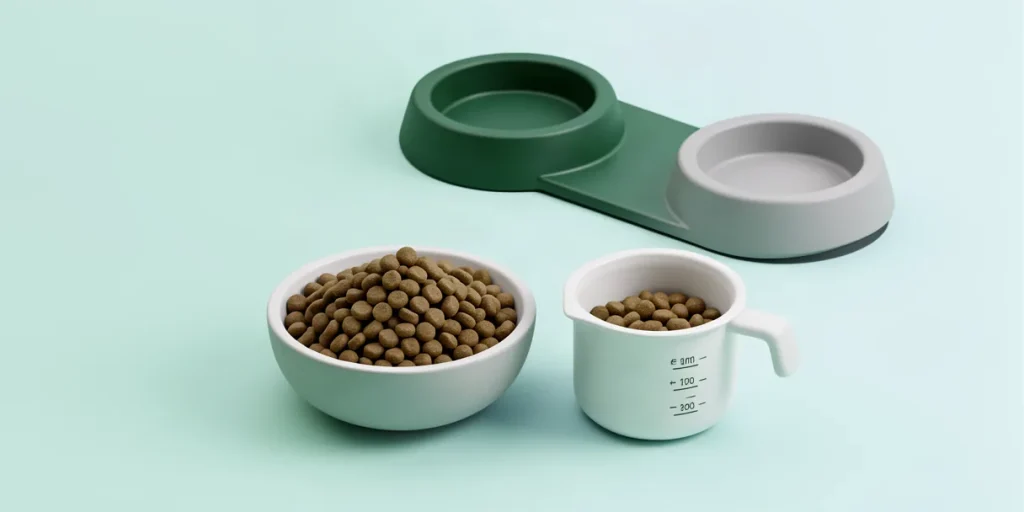
Transition your cat to wet food gradually, measuring the daily portion in advance based on its calorie content and reducing the amount of dry food. This helps you change your cat’s diet without inadvertently increasing the total amount of food.
Wet food contains more water, but that does not automatically make it lower in calories. As you make the switch, your cat may keep asking for its usual portion, so follow the feeding guidelines for the specific food and monitor your pet’s weight.
How you change the food and divide up portions depends on the products’ ingredients, your cat’s appetite, and its health. If your cat has a medical condition or special dietary needs, it’s best to discuss the transition plan with a veterinarian.
| Period | New food | Previous kibble |
|---|---|---|
| First four days | 25% | 75% |
| Days 5–9 | 50% | 50% |
| Days 10–14 | 75% | 25% |
| From day 15 | New diet only | None |
- 5-10% share of new wet food at the start of the transition
- 5-10% average moisture content in dry kibble
- 70-80% moisture content in canned food
- 37 degrees Celsius maximum serving temperature for food
How should you adjust the proportions to help your cat get used to wet food?
To help your cat get used to wet food without overfeeding, start with a small share of the new food—5-10% of its usual diet—and gradually increase it, keeping an eye on whether your cat eats both foods.
If your cat picks out only the kibble or only the wet pieces from the mixture, don’t leave that portion out: serve the foods separately and keep track of the total amount. That way, you can see how much of each food your cat has eaten and avoid adding extra food to make up for what it left behind.
Changing the proportions gradually
In the Purina PRO PLAN method, the old kibble and new food are changed in stages:
- For the first four days, serve 75% of the old kibble and 25% of the new food.
- From days 5 to 9, give equal amounts of the new and old food—50% of each.
- From days 10 to 14, increase the share of new food to 75% and reduce the share of the old food to 25%.
- From day 15, serve only the new diet.
Keep track of the portion at every stage: the percentage of new food does not mean simply adding another portion to the old amount. If your cat won’t eat one of the foods on its own, don’t mix it with the other—serve them separately.
Why is it important to recalculate calories when changing food types?
When switching to wet food, recalculate the calories: the same volume or weight of dry and wet food does not mean they have the same nutritional value.
Purina states that dry food contains an average of 5-10% moisture, while canned food contains 70-80%. So don’t replace dry food with wet food on a one-to-one basis by weight or volume: compare the calorie content per portion on both products’ packaging.
How to recalculate the transitional diet
- Add up the calories. Count the calories in the dry and wet portions separately while your cat is eating both types of food.
- Reduce the dry food. As you increase the portion of wet food, cut back on dry food so the new food isn’t added on top of the previous allowance.
- Check what the product is intended for. Look for the words “complete food” on the wet food packaging. A complementary food does not necessarily replace the main diet, even if your cat enjoys eating it.
Calorie content and whether a food is complete are different characteristics: the first helps you calculate a portion, while the second indicates whether the product is intended to be fed on its own. If the labeling is unclear, ask the manufacturer or a veterinarian how to combine that food with dry food.
How do you choose wet food for a complete diet?
For a complete diet, choose wet food labeled “complete food,” check its calorie content and feeding recommendations, then assess its ingredients and whether it suits your cat’s health.
- Complete food. Make sure the packaging explicitly says the food is complete. A product containing meat does not necessarily provide your cat with all the nutrients it needs.
- Calories and portion size. Compare the calorie content of this specific product with its feeding recommendations on the packaging. When switching to wet food, count it together with the rest of your cat’s food so you don’t inadvertently increase the total amount.
- Meat and nutrients. A meat content of 40–60% is often cited as a guideline. Also check whether taurine is listed: it’s an important nutrient for cats. A claim that a food is high in meat is not enough on its own—check whether information about essential nutrients is provided.
- Suitability for your cat. Take your pet’s age and health into account: the right ingredients depend on its condition. If you’re changing the diet because of health problems, discuss your food choice with a veterinarian first.
How can you tell if the new feeding plan is working?
The new feeding plan is working if your cat eats the portion offered, maintains its usual appetite and general well-being, and doesn’t gain weight from excess calories.
- Portion: Note how much wet food your cat eats and whether any is left in the bowl. If your cat picks only one type of food out of a mixture, it’s especially important to track how much it actually eats.
- Appetite and stools: During the transition, watch for changes in appetite, stools, or general condition. If your cat seems worse, don’t automatically increase the share of new food.
- Body weight: Check your cat’s weight while changing its diet. Adding wet food to the usual portion of kibble increases the total amount of food and can lead to overfeeding; count both types of food together.
When to see a veterinarian
Persistent digestive problems or other concerning changes are a reason to see a veterinarian. Until you’ve had a consultation, don’t increase the share of new food if your cat’s condition is getting worse.
How should you serve wet food and store leftovers?
Serve wet food in a separate bowl, don’t heat it above 37 degrees Celsius, and remove leftovers after feeding, storing them in a sealed container.
Your cat’s food should not be hotter than 37 degrees Celsius: hotter food can burn your pet. If the food has been in the refrigerator, bring it to a suitable temperature without heating it too much, and check it before serving.
How to store an opened package
After opening the package, check the storage time stated on it. Transfer any leftovers to a sealable glass or plastic container. Don’t leave uneaten food in the bowl until the next meal: remove it even if your cat hasn’t finished its portion.
Use separate bowls for dry and wet food. This keeps the wet food from mixing with the dry food and prevents leftovers from being left in the bowl for the next serving.
When should you pause or change a gradual transition?
Yes—stop increasing the share of wet food if your cat refuses the mixture or seems noticeably worse. Don’t coax your cat into eating or move on to the next stage just because the calendar says so; if its condition worsens, contact a veterinarian.
- Refusing the mixture. If your cat picks out only one food or won’t eat the mixture, serve the old and new foods separately. This lets you see how much of each your cat eats and assess its appetite.
- Risk of excess calories. Check that you haven’t left the full usual portion in place and added a full portion of wet food on top. Count both foods as part of the total diet rather than treating the wet food as an addition to the old amount.
- Medical restrictions. Don’t apply a standard transition schedule to a cat with prescribed dietary restrictions without consulting a veterinarian. First confirm which foods and portions are appropriate for your cat.
If your cat eats the mixture unevenly, serving the foods separately helps you track its appetite more accurately and avoid increasing the share of new food without knowing how much it’s eating.
Frequently asked questions
Can I replace dry food with wet food all at once?
How can I avoid overfeeding my cat during the transition?
Do I need to mix dry and wet food in the same bowl?
What temperature should wet food be?
Key takeaways
- Start with a small share of wet food and monitor your cat’s appetite and digestion.
- In the Purina PRO PLAN method, the new diet becomes the sole food from day 15.
- Count the combined calories in both portions rather than replacing one food with another by volume.
- Check that the product is a complete food, review its ingredients, and look for taurine.
- Store opened wet food according to the instructions and remove uneaten food from the bowl.
Sources
- zoozavr.ru — “How to switch a cat to a different food: What’s the right way?”
- clasifieds.ru — “How to switch a cat to a new food without upsetting its digestive system and protect its health — Clasifieds 360”
- dnovi.ru — “How to choose wet cat food: A detailed look at labels, nutrients, and choosing by age — dnovi.ru”
- vmiske.ua — “How to switch a cat to a new food safely and correctly”
- superpet.ru — “What to feed a puppy: Feeding guidelines and diet — superpet”