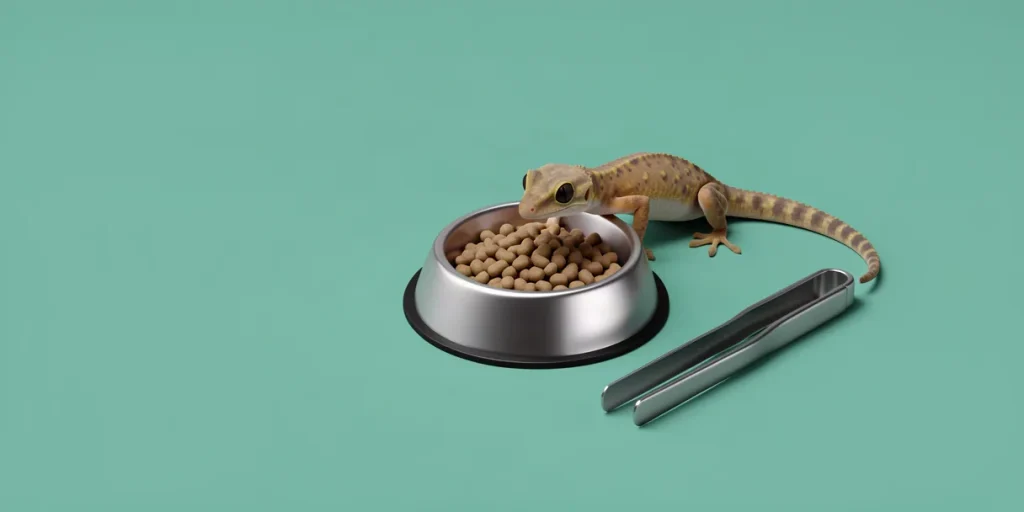
Geckos eat from tweezers because they are used to taking food that way or do not recognize it when it is offered elsewhere. Sometimes the animal’s housing conditions and health also affect whether it will eat from tweezers.
If your gecko refuses insects in a dish, that alone does not explain why. Consider how long it has eaten only from tweezers and whether its appetite or behavior has changed. We’ll look at when this is a habit and when it’s worth checking its housing conditions and health.
| Observation | What to check | Next step |
|---|---|---|
| Eats only from tweezers | Whether the food and the way it is offered are comparable | Offer the same food in a dish without removing the tweezers |
| Refuses familiar food from tweezers | Changes to the food, housing conditions or health | Stop the experiment and consult a veterinarian who treats reptiles |
| Refusal began after a change in how food is offered | Whether another factor changed at the same time | Return to the familiar feeding method and change only one thing at a time |
| The owner is relying on advice for children | Whether the recommendations are intended for reptiles | Do not use criteria for children as a diagnosis or set of instructions |
Which geckos may benefit from a gradual switch from tweezers to a dish?
A gradual switch from tweezers to a dish may suit a gecko that eats its familiar food from tweezers if you want to offer another way of feeding without immediately taking away the familiar one.
Tweezers are a way to offer food, not a diagnosis. Using them does not, by itself, explain why a gecko refuses a dish. Before making the switch, note exactly what food the animal accepts and under what conditions. That way, you can tell what has changed.
- The gecko eats familiar food from tweezers. Offer an alternative while keeping the familiar feeding method.
- You don’t know exactly what the animal accepts. First note the type of food and the feeding conditions.
- You plan to test its appetite by withholding the tweezers. Don’t remove the familiar feeding method or start the switch by making the gecko go hungry.
Don’t apply advice for children to geckos
For food selectivity in children, recommendations include offering a choice of several foods and gently introducing new ones. For a gecko, this approach does not establish whether a particular feeding method is safe: the animal’s needs and responses must be assessed separately.
Why don’t criteria for food selectivity in children apply to geckos?
ICD-10 and DSM-5 criteria cannot be applied to geckos: these classifications describe eating disorders in children, not reptiles.
Food selectivity in children often first appears between the ages of 1.5 and 3. This guideline relates to child development and does not explain a gecko’s behavior.
A gecko’s refusal to eat from a dish does not, by itself, prove that it is being fussy or is ill. Until its feeding, housing conditions and health have been checked, the cause remains unknown.
- Feeding: Check how and what food is offered.
- Housing: Assess the conditions in which the gecko lives.
- The animal’s health: Don’t draw conclusions about its health from a single refusal to eat from a dish.
Advice about children’s eating habits is not suitable for assessing a reptile’s behavior. Don’t diagnose the animal based on one sign: if your gecko continues to refuse a dish, discuss its feeding, housing conditions and health with a veterinary professional.
What should you check before changing how you offer food?
Before changing the feeding method, compare the food in the dish with what your gecko takes from tweezers: the type, condition and presentation should be comparable.
- Type of food: Offer in the dish the same food your gecko accepts from tweezers.
- Condition: Check whether the food looks the same when offered either way.
- Presentation: Compare exactly how the food is placed in front of the gecko. Don’t change the dish, food and way you offer it all at once.
- Housing and food: Consider whether the refusal began after a change in the animal’s housing conditions or food. Change only one factor at a time so you can tell what the gecko is responding to.
Also check whether your gecko will take its familiar food from tweezers. If it refuses food offered that way too, don’t assume the dish is the only issue: monitor the animal’s health.
If the refusal continues or your gecko’s condition has noticeably changed, consult a veterinarian who treats reptiles. Don’t try to solve the problem by withholding food.
How can you offer a dish without abruptly taking away the tweezers?
Offer the dish separately while keeping the familiar method of feeding with tweezers. This lets your gecko try a new approach without changing its diet at the same time.
Use the same food the animal usually accepts. Don’t push your gecko toward the dish or remove its familiar portion to speed up the switch: refusing tweezers shouldn’t mean going without familiar food.
Change only one thing per attempt. If you replace the dish, move the food and change how it is offered all at once, it will be hard to tell exactly what your gecko reacted to.
- Dish: Keep the food and the way you offer it with tweezers unchanged, and offer the dish separately.
- Food placement: Don’t change the dish and feeding method at the same time as moving the food.
- Feeding method: Keep everything else the same when checking whether your gecko will take the same food without tweezers.
Note which method your gecko accepts: food from tweezers, from a dish or both. If it stops taking even familiar food during your attempts, stop the experiment and check its health and housing conditions.
When is advice about food selectivity not useful?
Advice about food selectivity is not suitable for geckos when it is transferred from child-focused practice to reptiles: it does not establish either their diet or a safe feeding method.
The recommendation from Osnova Deti Clinic to offer a choice of several foods and gently introduce new ones is intended for children. It does not explain what to feed a gecko or confirm that it is safe to change how food is offered or to hand-feed it.
When to put a change in feeding method on hold
ICD-10 and DSM-5 do not provide grounds for diagnosing an eating disorder in a reptile by analogy with a child. A gecko’s refusal to eat from a dish therefore cannot, by itself, be explained by such a diagnosis.
A common mistake is to decide that the gecko is refusing food specifically because of the dish and keep changing how it is offered. But if it has stopped taking familiar food from tweezers too, the dish may not be the only issue; further experiments won’t explain the reason for the refusal.
If your gecko’s condition changes or the refusal continues, put the switch to a dish on hold until you have consulted a reptile specialist. Be sure to tell them that the animal has stopped accepting familiar food even from tweezers.
Frequently asked questions
Why does my gecko eat only from tweezers?
Should I take away the tweezers to get my gecko used to a dish?
Can I use advice about food selectivity in children?
When should a refusal to eat from a dish prompt a health check?
Key takeaways
- Tweezers are a way to offer food, not a diagnosis.
- Don’t switch your gecko to a dish by withholding food.
- Check the food, presentation and conditions one factor at a time.
- ICD-10 and DSM-5 criteria for children cannot diagnose a gecko’s condition.
Sources
- dalgau.ru — “Problems in Animal Husbandry, Veterinary Medicine and Biology”
- kgau.ru — “Student Research”
- lacerta.de — “Rock Lizards of the Caucasus”
- zin.ru — “Herpetology Questions. Proceedings of the Third Congress”
- spbguvm.ru — “79th International Scientific Conference of Young Researchers”