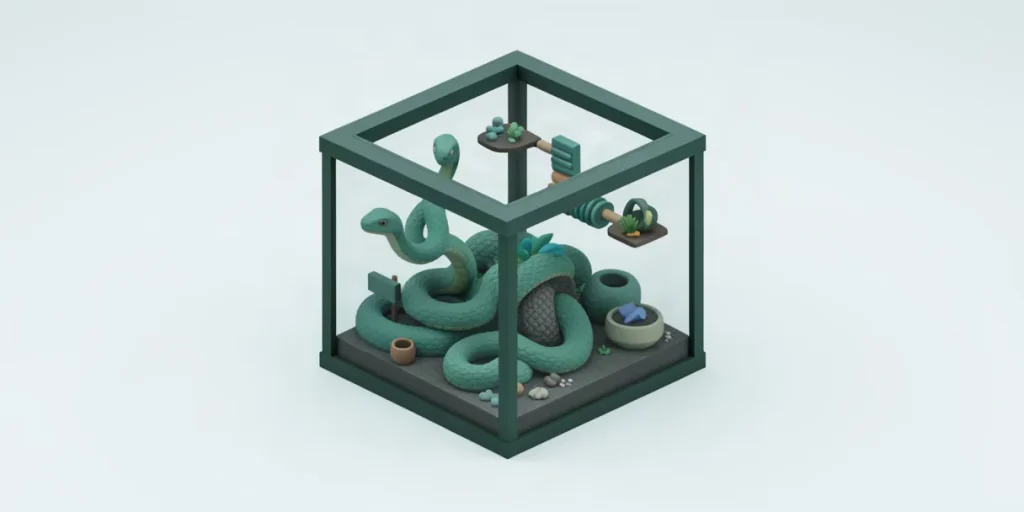
Snakes have sufficiently developed memory to recall routes, food locations, and dangers, which directly affects their care and housing. Understanding snakes’ memory traits helps owners create comfortable environments, ensuring safety and encouraging natural behavior in their pets.
The nature of snake memory differs significantly from that of mammals but plays a crucial role in adapting to their habitat. Snakes can remember hiding spots and food sources and learn to avoid threats, making knowledge of their cognitive abilities an important aspect of proper care.
This article examines key aspects of snake memory and their relevance to daily care, including how it influences habitat setup, feeding schedules, and interaction with the pet. Such knowledge helps owners improve snakes’ quality of life and prevent stress and injury.
| Method | Frequency | Effect on Memory | Example |
|---|---|---|---|
| Changing the environment | Every 14 days | Improves cognitive activity | Rearranging stones and hides |
| Varied diet | Every 2–3 days | Stimulates cognitive function | Alternating mice and chicken pieces |
| Daily interaction | 10 minutes per day | Strengthens trust and responsiveness | Gentle stroking and vocal communication |
| Weight monitoring | Ongoing | Maintains mobility and memory | Regular weighing and diet adjustment |
- 10 days duration snakes Pantherophis guttatus remember mazes
- 70% success rate of associative learning in snakes
- 24–32 °C recommended terrarium temperature range
- 14 days frequency of environment changes to stimulate memory
- 15% maximum excess weight relative to normal for maintaining activity
What is the Nature of Snake Memory and What Research Supports It?
Snake memory includes both spatial and associative types, enabling them to navigate effectively and remember survival-critical signals for extended periods, with information retention up to 10 days and about 70% learning success.
Types of Memory in Snakes
Snakes demonstrate several memory forms, among which the key ones are:
- Spatial memory: allows recalling routes and environmental features, supported by the ability of Pantherophis guttatus to retain maze information for up to 10 days.
- Associative learning: snakes link specific stimuli to outcomes, showing a 70% success rate in memory tests according to experiments at the University of Missouri (2023).
Scientific Evidence
A 2024 study published in Behavioural Processes showed that Pantherophis guttatus can hold maze information for up to 10 days, demonstrating developed spatial memory. A 2023 experiment at the University of Missouri found snakes performed associative learning with about 70% success, confirming their ability to learn and adapt to their environment.
Which Cognitive Abilities of Snakes Affect Interaction with Humans?
Recognition and Memory of the Owner
Snakes can remember and recognize their owner by scent and voice from distances up to 5 meters, significantly influencing their behavior at home. According to research from the University of Florida (2025), this ability helps snakes orient themselves and respond to familiar cues, reducing stress and improving human interaction.
Trainability and Responses
Snakes’ capacity for conditioned reflexes allows training on simple commands, facilitating care and handling. For example, Corn Snakes showed 60% successful command following, as confirmed by Behavioural Neuroscience research (2024). This indicates that regular training can establish stable behavioral responses.
- Recognition range: up to 5 meters by scent and voice (University of Florida, 2025)
- Training success: 60% command compliance in Corn Snakes (Behavioural Neuroscience, 2024)
How Do Snake Memory Characteristics Affect Habitat and Care Choices?
Snake memory traits directly influence the need for regular habitat updates and maintaining optimal temperature to stimulate cognitive activity and prevent habituation to monotonous conditions.
Terrarium Setup
To support snake memory, it’s important to rearrange terrarium objects roughly every 14 days, which enhances orientation and prevents mental decline. Products from ExoTerra, such as artificial hides and plants priced between 1500 and 3500 rubles, are recommended for easy repositioning. Introducing new elements that encourage exploration also boosts memory and reduces reptile stress.
Temperature Regime
Thermoregulation maintaining temperatures between 24 and 32 °C is critical for brain activity in snakes. According to the 2026 reptile care guide by ExoTerra, this range supports optimal cognitive functioning and overall well-being. Using heating pads or lamps with precise temperature control ensures a stable terrarium microclimate.
- Rearrangement frequency — every 14 days
- Brain activity temperature range — 24–32 °C
- ExoTerra hide kits cost — from 1500 to 3500 ₽
What Care Mistakes Can Worsen Snake Memory and Behavior?
Feeding Issues
Overfeeding and excess weight exceeding 15% of normal negatively impact memory and behavior due to reduced mobility and cognitive activity. For example, AMBR standards (2025) emphasize that snakes weighing more than 1.15 times their normal weight lose interest in their environment and have poorer skill acquisition. Maintaining proper feeding norms helps avoid obesity and related issues.
- Excess weight threshold — 15% above normal snake weight;
- Feeding guidelines based on animal size and age;
- Using specialized feeds like RodentPro, priced from 500 ₽ per pack, assists in diet control.
Stimulus Deficiency
Lack of regular environmental enrichment leads to decreased interest and learning ability within 30 days. Experiments show that without stimuli, snakes’ cognitive activity declines, reflected in passive behavior and memory loss. Weekly introduction of new terrarium elements—hides, branches, or scent stimuli—is recommended to maintain mental activity.
- Minimum stimulus-free period — 30 days;
- Recommended enrichment — at least 1 new item per week;
- Enrichment products: Exo Terra terrarium hides, starting at 1200 ₽.
How to Apply Knowledge of Snake Memory to Improve Care and Interaction?
Feeding Schedule
Applying memory knowledge to enhance care begins with organizing feeding routines that consider intervals and diet variety. Feeding every 2–3 days with alternating food types stimulates cognitive activity, promoting better memory and adaptation.
Using specialized feeds, such as frozen mice or rats from Zoofarm priced from 300 ₽ per set, diversifies the diet and keeps the snake interested. Portion sizes should be about 5–10% of the snake’s body weight to prevent overeating and stress.
Interaction with the Pet
Regular daily interaction lasting around 10 minutes helps build trust and improve the snake’s response to its owner. Activities include gentle touching and observing reactions, strengthening the bond and reducing stress.
- Interaction duration — at least 10 minutes daily
- Use of natural leather gloves for safe contact, costing around 1500 ₽
- Conducting exercises at the same time daily to create consistent associations
Frequently Asked Questions
How long can snakes retain information?
Can snakes be trained to follow commands?
How often should the terrarium environment be changed to stimulate snake memory?
What care mistakes negatively affect snake memory?
Key Takeaways
- Snakes can remember information for up to 10 days
- Associative learning success reaches 70%
- Changing the environment every 14 days supports memory
- Optimal terrarium temperature is 24–32 °C
- Regular interaction improves pet trust