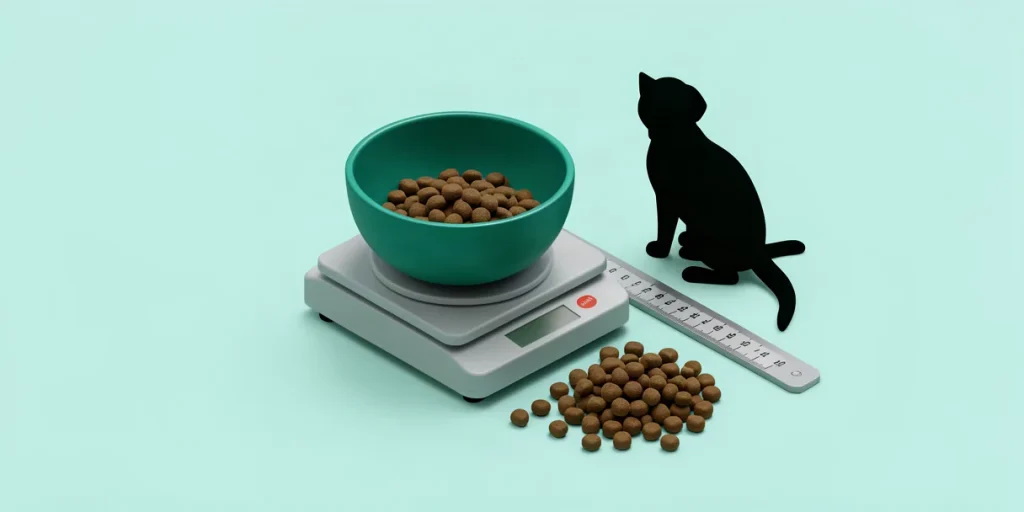
To calculate a portion for your pet, start with the recommendations for the specific food, then take the animal’s species, age, weight, activity level, and health into account. Treat the stated amount as a starting point: choose the right portion by monitoring changes in your pet’s weight and well-being.
A puppy, an adult cat, and an inactive pet have different needs, so there is no single universal measure. This article explains how to use the guidelines on the package, account for treats, and adjust your pet’s diet without overfeeding.
| Pet and life stage | What to consider | Specific guideline from the materials |
|---|---|---|
| Cat | Weight, age, activity | Daily allowance depends on all three factors |
| Kitten | Weight trend | About 10–15 g of weight gain per day |
| Adult dog | Weight, age, activity | Portion is approximate; weighing the food is recommended |
| 1–2-month-old puppy, small breed | Age and breed size | 5–6 feedings a day; 3–4-hour intervals |
| 1–2-month-old puppy, large breed | Age and breed size | 4 feedings a day; 3–4-hour intervals |
- 10–15 g per day Kitten weight-gain guideline cited in the materials
- 1–2 months Age of puppies in the feeding schedule provided
- 5–6 times a day Approximate feeding frequency for small-breed puppies aged 1–2 months
- 4 times a day Approximate feeding frequency for large-breed puppies aged 1–2 months
- 3–4 hours Interval between feedings in the puppy schedule provided
What information do you need to calculate a daily portion?
To calculate a daily portion, note your pet’s weight in kilograms, age, and activity level, then check these details against the feeding chart on the package of the food you actually use. Weight matters, but it does not determine the allowance on its own: all three factors need to be considered.
- Weight. Weigh your pet and use its current weight in kilograms. Compare it with the recommendations for the specific food, not with the allowance for a different product.
- Age. Kittens, puppies, and adult animals need different portions. For a puppy, also consider its rate of weight gain: the materials provided give a guideline of about 10–15 g per day, but this does not replace the individual recommendation on the package.
- Activity. Walks and play affect a dog’s food needs; for a cat, consider how active it is. If activity decreases with age, the previous portion may no longer be suitable.
Review your pet’s diet when its weight, age, or usual activity level changes. If the package information does not help you choose an appropriate allowance, ask a veterinary professional about portion size.
How do you calculate a cat’s portion based on weight and activity?
Calculate your cat’s daily portion using the amount on the food package for its weight, then adjust it for age and activity. Measure out the full daily amount in advance: if you feed your cat several times a day, divide that amount between meals without increasing the total.
- Weight: Choose the row on the package that matches your cat’s weight.
- Age and activity: Take both into account when choosing a portion, since they influence the daily allowance along with weight.
- Multiple feedings: Divide the calculated daily amount between meals.
Kitten: weight trends matter
A guideline for a kitten’s weight gain is about 10–15 g per day. Track changes in weight over time rather than relying on a single weigh-in, and compare the daily portion with the package recommendation for the kitten’s weight.
How do you determine a portion for a dog or puppy?
Set an adult dog’s portion according to the amount on the food package, then adjust it for the pet’s weight, age, and activity level. Measure dry food with kitchen scales at every feeding: this makes it easier to stick to the chosen daily allowance than estimating by eye.
- Adult dog: Use the manufacturer’s recommendation as a starting point and monitor any changes in body weight and activity level.
- Puppy: Take age and growth rate into account. The 10–15 g per day weight-gain guideline comes from materials about kittens; it should not be used to calculate a puppy’s portion.
1–2-month-old puppies: feeding frequency
The feeding schedule provided for puppies aged 1–2 months gives different frequencies depending on breed size: 5–6 feedings a day for small breeds and 4 for large breeds. Allow 3–4 hours between feedings.
These figures describe feeding frequency, not portion size: the amount of food for a puppy should be appropriate for its age and growth. If an adult dog’s weight changes or its activity decreases, review the actual portion and check it against the manufacturer’s recommendation.
When should you review the food allowance?
Review your dog’s portion when its weight, age, or activity level changes: the previous amount of food may no longer meet your pet’s needs. Pay particular attention to weight gain or loss, as well as decreased activity with age.
If walks or play have noticeably increased or decreased, weigh the usual portion again: a change in activity can affect energy expenditure. Don’t estimate food “by eye”—weigh the portion, check it against the package recommendation, and take your dog’s current weight into account.
What to check regularly
- Your dog’s weight: Keep track of whether it is gaining or losing weight—either change calls for a review of the amount of food.
- Age and activity: If an adult dog has become less active, its previous portion may be too large.
- Walks and play: Weigh the food again after a noticeable change in activity.
- Portion size: During regular checks, compare the actual weight of the food with the package recommendation rather than relying on your previous estimate.
Why might calculating a portion based on weight alone not work?
Calculating a portion based on weight alone may give you the wrong amount: a dog’s weight matters, but on its own it does not account for age, activity, or individual needs, and the amount on the package is only a guideline. Adjust the portion to your pet’s condition and weight changes rather than treating it as a universal amount for all dogs of the same weight.
Common recalculation mistakes
Estimating dry food “by eye” can be risky: even a familiar bowl does not guarantee the same volume each time. Measure the right portion once, then weigh each serving—this makes it easier to stick to the chosen amount.
- Puppy and adult dog: The schedule of 4–6 feedings a day applies to puppies aged 1–2 months; it should not be used for an adult dog.
- Kitten and daily portion: The guideline of 10–15 g of weight gain per day describes a kitten’s weight gain, not the amount of food. It is not a universal target for other types of pets.
How can you check whether the chosen portion is right?
Check whether the portion is suitable by comparing the actual daily weight of the food with the package recommendation and tracking changes in your pet’s weight. Keep a record of how much food your pet gets each day and when you change the portion: this helps you compare dietary changes with changes in weight.
What to watch for in a dog and a kitten
- Adult dog: Regularly track weight and activity level. If the dog’s weight changes or it becomes less active, reassess its daily food amount in light of these changes.
- Kitten: Monitor weight gain. The guideline in the materials is about 10–15 g per day; use it to track the trend, not as a reason to automatically increase the portion at every weigh-in.
The package recommendation is a starting point, not a guarantee that the same portion will suit an animal at any weight or activity level. If your pet’s weight changes or you are unsure about the right allowance, don’t rely on a universal chart in place of an individual assessment: first compare your records of feeding, weight, and activity, then review the portion in light of what you have observed.
Key takeaways
- Calculate the daily allowance based on weight, age, and activity.
- Measure dry food with kitchen scales rather than estimating by eye.
- For puppies aged 1–2 months, the schedule gives 4 or 5–6 feedings a day, depending on breed size.
- The guideline of about 10–15 g per day refers to kitten weight gain.
Frequently asked questions
Can you calculate a pet’s portion based on weight alone?
Should you weigh dry food?
How often should you feed a 1–2-month-old puppy?
What weight gain is recommended for kittens?
Sources
- cosmopet.ru — “How to Calculate a Cat’s Daily Food Portion”
- royal-canin.ru — “Dog Owners Often Get Portion Sizes Wrong”
- Royal Canin EE — “Healthy Portions for Dogs — Royal Canin”
- Pet Food Calculator — “Apps on Google Play”
- 4lapy.ru — “How Many Times a Day Should You Feed a Dog?”
