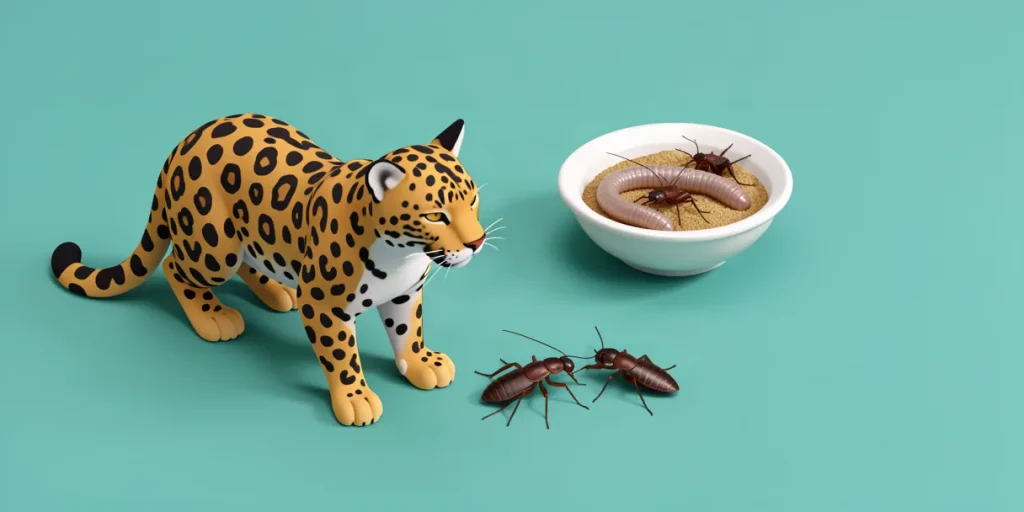
Leopard geckos are fed live feeder insects: their diet usually consists mainly of crickets, roaches, and larvae of suitable species. Choose insects that are an appropriate size for the gecko and dust them with nutritional supplements before feeding; plant foods and meat are not substitutes for this kind of food.
Feeding frequency and the number of insects depend on the leopard gecko’s age and body condition, so it is important to monitor your pet rather than rely on appetite alone. The diet table explains which feeder insects to offer and what to watch for when feeding.
| Age or role | Food | What is specified |
|---|---|---|
| 0–2 months | Crickets | 2–3; frequency is contradictory: daily or once every 4 days |
| From 1 year | Large crickets | 10–15 |
| Diet staple | Crickets and roaches | Main feeder insects |
| Treat | Mealworms, superworms | Not a dietary staple |
| Between 2 months and 1 year | No separate amount given | Not specified in the source materials |
- 0–2 months age range for which a cricket serving is specified
- 2–3 crickets specified serving for leopard geckos under 2 months old
- Once every 4 days one of the stated feeding-frequency options for young geckos; the same material also says “every day”
- 10–15 large crickets specified guideline for leopard geckos from 1 year old
What makes up a leopard gecko’s staple diet?
Leopard geckos’ staple diet consists of feeder insects, primarily crickets and roaches. You can add variety to their diet by combining these two types, rather than replacing staple foods with larvae.
Crickets and roaches on the menu
Crickets are suitable for leopard geckos of different ages: they are listed as food for animals from 0 to 2 months old and for adults. The feeding guidelines for young geckos specify 2–3 crickets per meal; for geckos from 1 year old, they specify 10–15 large crickets. These figures refer to a feeding regimen and are not a universal serving size for every leopard gecko.
Roaches can supplement crickets and help provide variety in feeder insects. Mealworms and superworms should not be considered equivalent substitutes for staple foods: the recommendations provided mention them as treats, not as dietary staples.
What leopard geckos eat in the wild
In the wild, leopard geckos also eat spiders, small lizards, and rodents. This list describes their natural prey, but it is not a recommendation to include these animals in a pet’s diet: feeder insects, particularly crickets and roaches, make up the staple diet.
How many crickets should you feed a leopard gecko at different ages?
A serving of 2–3 crickets is specified for leopard geckos from 0 to 2 months old, while 10–15 large crickets is the guideline from 1 year old. The feeding schedule given alongside the serving for young geckos is contradictory: it says both “every day” and “once every 4 days,” so these statements do not establish a definitive frequency.
How to interpret the age-based guidelines
For leopard geckos under 2 months old, the figure of 2–3 refers to the number of crickets per serving, but it does not resolve the contradiction between daily feeding and feeding once every four days. Do not choose one of these schedules based only on this information; consult a reptile specialist to confirm the schedule.
The guideline for leopard geckos from 1 year old is 10–15 large crickets; the word “large” matters because insect size affects the actual serving size. Age-based figures alone do not establish the right amount for every individual, so take cricket size and the animal’s condition into account, and do not treat the conflicting frequency given for young geckos as a definitive recommendation.
Can you feed mealworms and superworms?
Yes, you can offer mealworms and superworms to a leopard gecko, but only as treats, not as dietary staples. Base regular feedings on crickets and roaches; for variety, choose these insects first rather than larvae.
Mealworms and superworms are dessert-like options: they should not become regular replacements for crickets and roaches. Feeding materials also warn against fatty foods, which include various types of worms and larvae.
What “occasionally” means
“Occasionally” and “treat” describe the role of mealworms and superworms, but they do not specify an exact frequency or serving size. The recommendations given therefore do not provide a basis for setting a schedule for these foods—for example, a specific number of larvae or a number of days between treats.
Do not apply the cricket guidelines to worms: the materials separately specify 2–3 crickets a day for leopard geckos under two months old and 10–15 large crickets for animals from one year old. These figures apply to crickets and do not set the amounts of mealworms or superworms to feed.
Why aren’t fatty larvae suitable as a staple?
Fatty larvae are not suitable as a leopard gecko’s staple food because crickets and roaches are recommended for a regular diet, while mealworms, superworms, and waxworms are treats that should be fed sparingly. It is important to distinguish an occasional treat from food the lizard receives regularly.
Staple foods and treats are not the same
For a leopard gecko’s daily diet, feeder crickets and roaches are the safer choices: these are the insects identified as staples. Mealworms and superworms can be offered as treats, but their presence in the diet does not make larvae suitable as regular food.
- Crickets and roaches — the feeder insects identified as dietary staples.
- Mealworms and superworms — treats, not daily substitutes for staple foods.
- Waxworms and other larvae — examples of fatty foods that are recommended against.
The maximum acceptable proportion of larvae in a leopard gecko’s diet is not specified, so no exact percentage or feeding frequency can be assigned. The practical guideline here is not an invented numerical limit, but the distinction between a staple diet of crickets and roaches and an occasional mealworm or superworm treat.
Which diet information should not be applied to all lizards?
The diet and feeding schedule specified for leopard geckos should not be treated as standard for all pet lizards: 2–3 crickets applies to feeding young leopard geckos, while the guideline of 10–15 large crickets applies to animals from 1 year old. The information provided does not establish servings or schedules for other species, so these figures should not be applied to them.
What these recommendations actually cover
The leopard gecko feeding information contains an inconsistency: for animals under 2 months old, it specifies both “every day” and “once every 4 days.” These intervals contradict each other, so they do not allow you to confidently determine the feeding frequency even for leopard geckos.
- Natural prey: Insects, spiders, small lizards, and rodents are listed as food leopard geckos eat in the wild. This does not mean that all of these should be offered at home.
- Food at home: Crickets and roaches are named as dietary staples, while mealworms and superworms are treats. This information applies to leopard geckos and does not set a menu for other pet lizards.
Thus, the figures 2–3 and 10–15 describe specific recommendations for leopard geckos, not universal servings for lizards. The materials provided do not give separate feeding guidelines for other species.
How to read the feeding table without implying false precision
Read the leopard gecko feeding table as a set of specific guidelines, not as a fully consistent schedule: it specifies 2–3 crickets for animals from 0 to 2 months old, but gives conflicting information about frequency. One version says “every day,” while another says “once every 4 days,” so the table does not let you choose between these schedules without additional guidance.
What the table actually shows
- From 0 to 2 months: Keep to the specified serving of 2–3 crickets; do not combine the two different statements about frequency into a single precise schedule.
- From 1 year: 10–15 large crickets is the guideline given for this age group, not a universal serving for every leopard gecko.
- Diet staple: Crickets and roaches; mealworms and superworms are listed as treats, not equivalent substitutes for staple foods.
- From 2 months to 1 year: No separate guideline is given in the material provided, so do not try to calculate one from the neighboring age groups.
This approach preserves the figures in the table without creating an impression of precision where information is insufficient. This is especially important for the period from 2 months to 1 year and the conflicting feeding frequency for young geckos. Mealworms and superworms should not be treated as everyday staples either: the material specifically identifies them as treats.
Key takeaways
- Crickets and roaches are the staples of a leopard gecko’s diet.
- For ages 0–2 months, 2–3 crickets are specified, but the feeding frequency is described inconsistently.
- For leopard geckos from 1 year old, the guideline is 10–15 large crickets.
- Mealworms and superworms are treats, not dietary staples.
Frequently asked questions
How many crickets should you feed a gecko under 2 months old?
How many crickets are specified for a leopard gecko from 1 year old?
Are mealworms and superworms staple foods?
Can you use a leopard gecko’s feeding schedule for any pet lizard?
Sources
- happygeckofarm.com — “Leopard Gecko Care”
- 4lapy.ru — “Leopard Gecko: Care and Keeping at Home”
- how to feed geckos at different — “Feeding Leopard Geckos”
- lavka-kipera.ru — “Keeping a Leopard Gecko at Home”
- lavka-kipera.ru — “How to Feed a Leopard Gecko Properly to Prevent”
