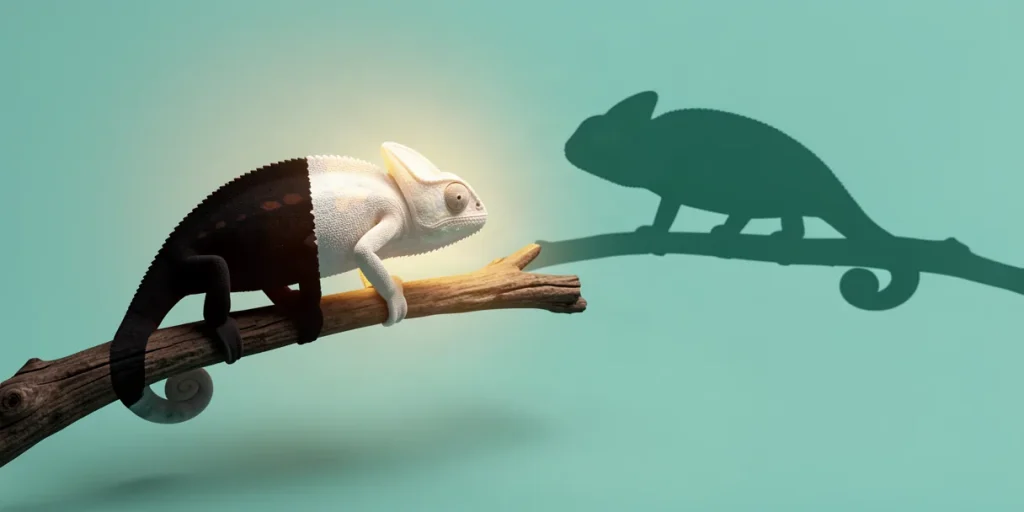
Chameleons change color for more than camouflage: it helps them regulate heat and send signals to other animals.
Their color depends on the reptile’s condition and its surroundings. A color change may signal stress, readiness to interact, or a need to warm up—which is why the same chameleon can look different in different situations.
To understand why a chameleon changes color, it is important to consider several possible reasons rather than judge by the brightness of its color alone.
| Observation | Possible meaning | What to check |
|---|---|---|
| Darker shade | Heat absorption or a response to stress and threat | The temperature and surroundings |
| Lighter shade | Heat reflection | The temperature in the terrarium |
| Color change near another animal | Communication, dominance, or attracting a mate | The behavioral context and whether another chameleon is present |
| Color does not match expectations about camouflage | The color change may serve another function | The animal’s species and living conditions |
Why do chameleons change color?
Chameleons change color to regulate body heat and send signals to other animals: their color depends not only on the background but also on their condition and surroundings.
Darker shades absorb more heat from the sun or a lamp, while lighter shades reflect it. Color changes therefore help chameleons respond to heating conditions.
Color also serves as a signal. Other animals may read it as an indication of the chameleon’s condition and reaction to what is happening; stress or a threat may be accompanied by darker coloration.
The image of the chameleon as a master of camouflage is incomplete: blending into the background is just one possible function of its coloration, not the only explanation for color changes—and not the main one.
How color change was explained in ancient times
In History of Animals, Aristotle mentioned a lizard’s ability to change color. Pliny the Elder linked changes in coloration to the animal’s surroundings. These explanations focused on the noticeable resemblance to the environment, but today color change is also understood as a way to regulate body temperature and communicate.
How does color help chameleons regulate temperature?
Chameleons change shade to regulate heat exchange: in cool conditions, they darken and absorb more heat; in hot conditions, they lighten and reflect it.
Chameleons depend on the temperature of their surroundings and do not maintain a constant body temperature in the way warm-blooded animals do. Sunlight and a terrarium lamp therefore serve as heat sources, while coloration affects how much heat the animal absorbs or reflects.
Dark coloration helps a chameleon warm up, but it does not by itself mean the animal is cold. A lighter shade may reduce heat absorption, but it does not show exactly how hot the animal feels.
How to assess coloration in a terrarium
Consider color alongside the conditions in the terrarium: note where the chameleon is—under the lamp or in a cooler area—and how it behaves. A single shade is no substitute for assessing the temperature and surroundings.
What does color tell other chameleons?
Coloration helps chameleons send signals to one another: it may indicate dominance or attract a mate.
When another animal appears nearby, a change in shade may be part of a social interaction. But color alone does not reveal intent: the same shade cannot be interpreted without considering the chameleon’s behavior and the situation it is in.
For example, the presence of a rival and an encounter with a potential mate are different contexts, even though both may be accompanied by a change in coloration. To understand the signal, observe not only the color but also who is nearby and how the chameleon behaves.
Why coloration was linked to the background
Historically, color change was often explained as an adaptation to the surrounding surface. Aristotle mentioned a lizard changing color, while Pliny the Elder linked an animal’s color to its surroundings.
This explanation does not account for the full role of coloration: in chameleons, it also plays a part in communication. So when you notice a color change, first consider the circumstances—especially whether another chameleon is present, how the animal is behaving, and whether there may be a threat.
When can darkening indicate stress?
Darkening may indicate stress if a chameleon turns darker in response to a threat or an unsettling situation, but it does not prove stress on its own.
Coloration helps chameleons regulate temperature: darker shades absorb more heat, while lighter shades reflect it. Darkening may therefore be linked not to fear but to an attempt to warm up near a heat source.
What to check
- The surroundings. Note whether a threat or another factor that could have caused an alarm response has appeared nearby.
- The temperature in the terrarium. Compare it with the color change and check whether the chameleon is near a heat source.
Assess color in light of the circumstances and temperature, not in isolation. The same dark shade may accompany different reactions.
If unusual coloration persists, check the animal’s living conditions and discuss its condition with a veterinarian who specializes in reptiles.
Where do chameleons live, and why does it matter when interpreting their coloration?
A chameleon’s range matters when interpreting its coloration: different species live in different conditions and do not share the same color palette or show color changes to the same degree. Chameleons live mainly in Africa, especially Madagascar and neighboring islands.
Some species are found in Spain, on the southern Mediterranean islands, in the Middle East, and in Southeast Asia. So the familiar image of a chameleon that quickly adapts to any background does not apply to every member of the group.
What owners should consider
Some species change color noticeably, while others change only slightly. Color is linked not only to the background: it also helps regulate heat and send signals to other animals. Darker shades help absorb heat, while lighter shades help reflect it.
When assessing a pet chameleon’s behavior, take its species and living conditions into account rather than expecting it to change color to match any background. A change in shade may be related to temperature, communication, or stress; if its coloration or behavior concerns you, check its living conditions and discuss your observations with a reptile specialist.
Why does a color change not always mean camouflage?
Chameleons do not necessarily change color to camouflage themselves: their shade helps regulate heat and send signals to other animals.
The expectation that a chameleon will turn the color of an object beside it is a common oversimplification. Coloration depends on temperature, communication, and responses to stress or threats. A darker color may help absorb heat from a source, while a lighter one may reflect it; color changes may also be linked to displays of dominance or attracting a mate.
How to assess a color change
The same dark shade may have different causes. To understand the context, check whether the chameleon is warming itself under a lamp, whether another animal is nearby, and whether its behavior has changed.
- Terrarium conditions: Check the temperature and lighting, as well as access to a heat source.
- Communication: Notice whether the color changes when another animal appears.
- Stress or threat: Consider the surroundings and the chameleon’s behavior, not just its skin color.
You cannot judge a chameleon’s health from a single color change. Compare its coloration with the terrarium conditions and its overall behavior; if the changes concern you, consult a veterinarian who treats exotic animals.
Frequently asked questions
Do chameleons change color to hide?
Why does a chameleon get darker?
What does light coloration mean?
Should I change the lighting if my chameleon has darkened?
Key takeaways
- Dark shades help absorb heat, while light shades help reflect it.
- Chameleon coloration plays a role in communication, including displays of dominance and attracting a mate.
- Darkening may be related to either temperature regulation or stress; context matters.
- A chameleon’s species and living conditions should be taken into account when assessing its coloration.
Sources
- sigmaearth.com — “How and why does a chameleon change color? — Sigma Earth”
- zooclub.ru — “Why does a chameleon change color? Why does a chameleon change its color? A report for school grades 3, 4, 5, 6, 7, 8, 9, 10”
- deti.mail.ru — “Why chameleons change color: a short and simple answer for children — Kids Mail”
- oncovet.ru — “How and why chameleons change color — Pride Veterinary Center”
- vpoxod.ru — “Chameleon: what it is, species, how it changes color, behavior, what it eats”