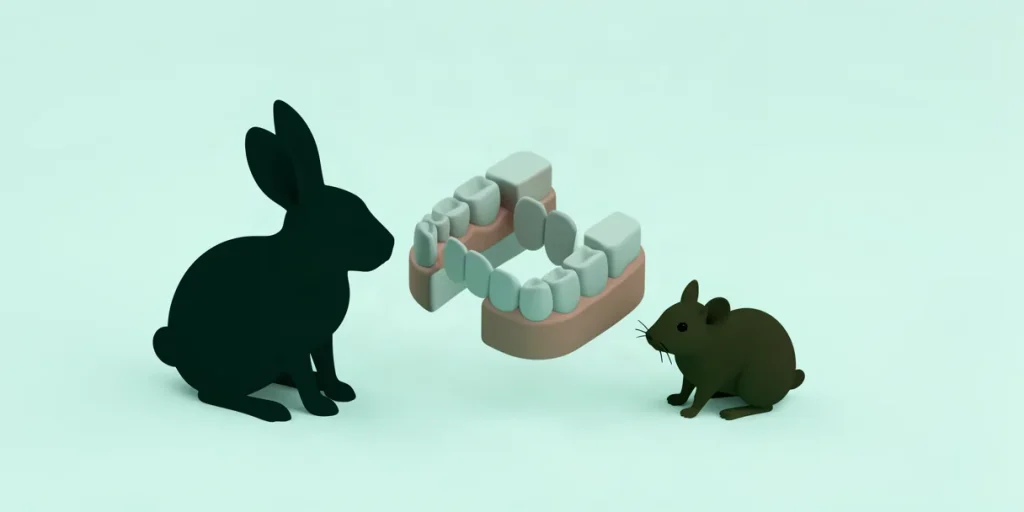
Rabbits are not rodents: they belong to the order Lagomorpha. The main visible difference is that rabbits have two pairs of upper incisors, while rodents have one; their dentition and some aspects of digestion also differ.
In everyday speech, rabbits are often called rodents because their habits and care seem similar, but biologically they are different groups of animals. Let’s look at how rodents and rabbits differ and why this matters for understanding their characteristics; for more on how hares and rabbits are related and how they differ, read our article “Hares and Rabbits: Differences, Lifestyle, and Care.”
| Criterion | Rabbits | Rodents |
|---|---|---|
| Taxonomic order | Lagomorpha | Rodentia |
| Upper incisors | Two sets, one behind the other | No second set like the one rabbits have |
| Common ancestor | Share a common ancestor with rodents | Share a common ancestor with lagomorphs |
| Birth information | Baby rabbits are born blind and hairless | No comparative information is provided in the material |
- 2 sets of upper incisors A dental feature of rabbits: the rows are positioned one behind the other
- 2 orders Rabbits belong to Lagomorpha; rodents belong to Rodentia
- about 1000 years The period over which rabbits were domesticated, according to material from a veterinary center
Why isn’t a rabbit a rodent?
Rabbits are not rodents: in zoological classification, they belong to the order Lagomorpha, while rodents belong to a separate order. This distinction holds even though rabbits are sometimes called rodents in everyday speech because they look similar and have a habit of gnawing.
Rabbit incisors help explain why appearance alone is not enough for classification: rabbits have two sets of incisors, one behind the other, whereas rodents are characterized by having a single set. Similar traits can arise independently in different groups of animals; this is called convergent evolution.
How evolutionary relationships are determined
Rabbits and rodents are assigned to different orders based not on a single name or noticeable trait, but on a combination of anatomical and genetic features. Genetic analyses point to a common ancestor of these groups and allow them to be combined into the broader taxon Glires, but this does not erase the distinction between lagomorphs and rodents.
- In everyday speech: the word “rodent” may be used broadly, including for rabbits.
- In zoology: a rabbit is a lagomorph, while rodents belong to their own order.
How do rabbit teeth differ from rodent teeth?
The main difference is that rabbits have another, smaller pair of incisors behind their front upper incisors, while rodents do not have this second row. So having large front teeth that look alike does not make a rabbit a rodent: rabbits belong to Lagomorpha, while rodents belong to a separate order.
What you can see on examination
Rabbits have two pairs of incisors on the upper jaw, one behind the other: the front pair is larger, while the back pair is smaller and may not be noticeable during a routine examination. These rear upper incisors are the distinctive feature that sets a rabbit’s tooth row apart from a rodent’s.
The phrase “two sets of incisors” refers only to the rabbit’s upper jaw, not all its teeth: it means two pairs of upper incisors arranged one behind the other. Rodents do not have a second pair of upper incisors. Since both rabbits and rodents have prominent front incisors, it is easy to mistake them for one another based on their resemblance; the key classification feature is the extra row in rabbits, not just the appearance of their front teeth.
What does genetics tell us about their common ancestor?
Genetics indicates that lagomorphs, which include rabbits, and rodents shared a common ancestor, but today they belong to different mammalian orders. A review of analyses allows these groups to be combined into the broader taxon Glires, but this grouping does not change their current classification.
Shared ancestry and modern classification
Rabbits remain lagomorphs, while mice, squirrels, and other rodents belong to the order Rodentia. Shared ancestry describes the relationship between branches of the evolutionary tree, while an order name describes their position in the modern taxonomic system; one does not dictate the other.
- Rabbits: lagomorphs; their distinctive feature is two sets of incisors, one behind the other.
- Rodents: an order separate from Lagomorpha; their resemblance to rabbits does not make them the same group.
- Glires: the broader grouping of lagomorphs and rodents proposed in the review, reflecting their relationship through a common ancestor.
Thus, genetic relatedness does not mean that a rabbit is a rodent: they are different modern orders with a shared evolutionary past. However, the review provided does not name a specific genetic study or date, so it is more accurate to describe this as a general conclusion rather than attribute it to a particular study.
What should you know about digestion and reproduction?
Digestion and reproduction cannot be reduced to a single pattern for all rodents and rabbits: the materials provided do not offer an overall comparison of these processes or numerical data on reproduction. So you cannot automatically assume that the same diet suits animals in both groups or that they reproduce in the same way.
What is known about baby rabbits
Rabbits belong to Lagomorpha, not Rodentia; this distinction also matters when describing their offspring. The materials note that baby rabbits are born blind and hairless, unlike leverets. This example shows differences between rabbits and hares within Lagomorpha, but it does not describe every member of the order.
- Digestion: the materials provided contain no general information that would establish a single diet for rabbits and rodents.
- Reproduction: no comparative numerical data for both groups is given; the characteristics of an individual species cannot be generalized to all rodents or rabbits.
- Rabbit offspring: the stated feature—being born blind and hairless—applies to baby rabbits and distinguishes them from leverets; it does not describe rodents.
How does classification help you choose the right care for a pet?
Classification helps prevent care recommendations for rodents from being applied to rabbits: rabbits belong to Lagomorpha, while rodents belong to a separate order. That is why a care plan should be chosen for the particular species and animal, not based on the broad category “rodents and rabbits.”
The veterinary resource “Rodents and Lagomorphs” discusses rabbits separately from rodents—a useful reminder when seeking a consultation or choosing recommendations. Vet Union’s laboratory services use the phrase “rodents and rabbits” to group the animals in one list of services, but placing the words side by side does not change the classification of rabbits.
What to consider when choosing care
- Animal species: first establish whether it is a rabbit or a rodent; for example, rabbits have two sets of incisors, one behind the other.
- The individual animal: take its health and specific needs into account, not just its membership in a broad group.
- Source of the recommendation: look for advice intended specifically for that species; a general category is no substitute for species-specific guidance.
For general background on rabbits and hares, read “Hares and Rabbits: Differences, Lifestyle, and Care.” It will help explain why even animals that look similar need different approaches to their care.
What mistakes arise when comparing these animals?
Mistakes in comparing rabbits and rodents arise when prominent incisors are treated as sufficient proof of relatedness, a common ancestor is taken as proof that they belong to one group, or a taxonomic label is mistaken for a ready-made care guide. Rabbits belong to Lagomorpha, while rodents belong to Rodentia; their common ancestor does not erase the distinction between these orders.
- Mistake one — assuming a rabbit is a rodent because of its incisors. Rabbits have a second set of upper incisors behind the front ones. So similar-looking teeth alone are not enough to classify a rabbit as a rodent.
- Mistake two — confusing a common ancestor with modern classification. Genetic analyses point to a common ancestor of rabbits and rodents, and the groups may be combined into the broader taxon Glires. Even so, the classification retains two orders: Lagomorpha and Rodentia.
- Mistake three — deriving care requirements from an order’s name. Taxonomic classification alone does not tell you how often to feed an animal or how long its pregnancy lasts or how large its litters are. The available information does not provide detailed comparative data to support such conclusions.
This overview allows us to compare the orders, the placement of the upper incisors, and whether the animals share a common ancestor. The source information contains no numerical feeding guidelines or data on gestation periods and litter sizes, so these cannot be presented as established differences.
Key takeaways
- Rabbits belong to Lagomorpha; rodents belong to a separate order.
- Rabbits have two rows of upper incisors, one behind the other.
- A common ancestor does not make rabbits and rodents members of the same order.
- Baby rabbits are born blind and hairless; this information should not automatically be applied to rodents.
Frequently asked questions
What order does a rabbit belong to?
What dental feature distinguishes a rabbit from a rodent?
If rabbits and rodents share a common ancestor, why are they different groups?
Are baby rabbits born the same way as leverets?
Sources
- Zoovet Veterinary Center in Moscow — “Rodents and Lagomorphs”
- 24tv.ua — “Myths About Rabbits: What Is Known About Rabbits”
- appropedia.org — “Micro-livestock/Part 4: Rodents/Micro-livestock”
- vetunion.ru — “Tests for Rodents and Rabbits in Moscow”
