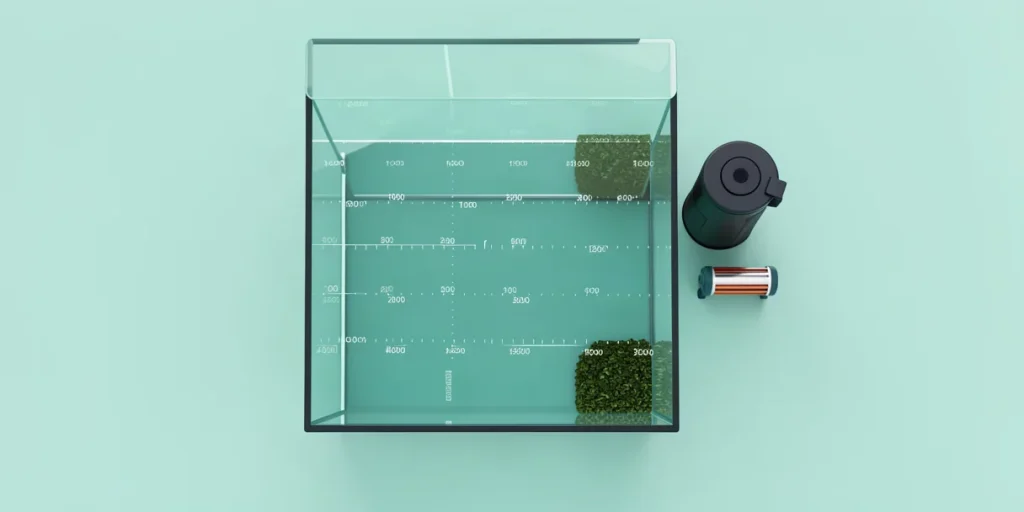
Choose an aquarium based on the adult size and number of fish, their needs, and the space available. Calculate its volume using the internal dimensions: multiply the length by the width and height in centimeters, then divide the result by 1000.
This gives you the geometric volume, not the amount of water in a filled aquarium: substrate and decorations take up some of the space. So when calculating, account for the future inhabitants and equipment, not just the tank’s dimensions.
Let’s look at how many liters an aquarium needs for different purposes and how to choose a size that’s easy to place and maintain.
| Shape and dimensions | Calculation | Volume |
|---|---|---|
| Rectangular, 60×30×40 cm | 60 × 30 × 40 cm³ | 72 liters |
| Cubic, 30×30×30 cm | 30 × 30 × 30 cm³ | 27 liters |
| Cylinder, diameter 30 cm, height 30 cm | 3,14 × 15 × 15 × 30 ÷ 1000 | 21,2 liters |
- 27 liters Volume of a cubic aquarium measuring 30×30×30 cm
- 72 liters Geometric volume of an aquarium measuring 60×30×40 cm
- 21,2 liters Volume of a cylinder with a diameter of 30 cm and a height of 30 cm
How do you calculate an aquarium’s usable volume?
Calculate a rectangular aquarium’s usable volume using its internal length, width, and height: multiply the measurements in centimeters and divide the result by 1000.
Start with the internal dimensions
External dimensions show the geometric volume of the tank, not the exact amount of water it will hold. If you measure the aquarium from the outside, account for the glass thickness: the sides and bottom reduce the space inside.
For example, an aquarium measuring 60×30×40 cm has a geometric volume of 72 liters: 60 × 30 × 40 = 72 000 cm³. This calculation uses the stated dimensions; the water level and substrate can reduce the amount of water in the assembled aquarium.
The shape changes the calculation
- A cubic aquarium measuring 30×30×30 cm holds 27 liters: multiply the length, width, and height just as you would for a rectangular tank.
- A cylinder with a diameter of 30 cm and a height of 30 cm has a volume of 21,2 liters. Use the formula: 3,14 × radius² × height ÷ 1000; the radius is half the diameter.
For a cylinder, don’t substitute the diameter for the radius: first find the radius, then square it. To estimate the amount of water, measure the internal dimensions and calculate up to the intended fill level.
How do you choose a volume that suits your fish?
Choose an aquarium volume based on the fish species and their adult size: add together the length of the fish you plan to keep for a preliminary estimate, then check each species’ space requirements.
A guideline for small fish
The rule “1 cm of fish per 1 liter of water” is used for small fish measuring up to 5–7 cm. It’s only a rough guide: it doesn’t account for fish behavior or how much swimming space they need.
Fish length can help you compare options, but it doesn’t determine the right volume on its own.
- Species and adult size: Find out how large the fish will grow before deciding how many to keep.
- Total length: Add together the length of the fish you plan to keep and use the result only as a preliminary estimate.
- Geometric volume: An aquarium measuring 60×30×40 cm has a geometric volume of 72 liters: 60 × 30 × 40 = 72 000 cm³.
Larger fish need length
For larger fish, the volume in liters isn’t enough to settle the question. The aquarium’s length and shape matter, as does an open area for swimming: a tall, narrow tank and a long aquarium with the same volume offer different amounts of room to move.
Before choosing, match the aquarium’s shape to the adult size and habits of the particular species.
What reduces the amount of water after setup?
The actual amount of water after setup is less than the aquarium’s internal volume: substrate and equipment take up some of the space.
Substrate reduces the amount of water, so calculating based on the glass height overestimates how much will fit in a filled aquarium. A filter, heater, and other equipment also displace water—account for them when estimating the usable volume.
A calculator using external dimensions and glass thickness can help you work out the internal dimensions, but it doesn’t account for substrate or installed equipment. For example, a cylinder with a diameter of 30 cm and a height of 30 cm holds 21,2 liters; this geometric estimate doesn’t show how much water will remain after the aquarium is decorated.
For a quarter-circle corner aquarium, the base is shaped like a quarter circle, and the radius is equal to the length of the wall along the corner. Here, too, calculating the shape doesn’t replace estimating the volume displaced.
If you need to know the actual amount of water it holds, go by how much water you add when filling it, not just the model’s label. Record how much water you add before reaching the desired level.
When is a small aquarium not the best choice?
A small aquarium isn’t the best choice if your fish need more swimming space and you’re not ready to monitor water quality and cleanliness regularly.
Where the centimeter rule falls short
The “one centimeter of fish per liter of water” rule is only a rough guide for small fish, not a way to choose an aquarium for every species. It doesn’t account for the fish’s adult size or the space it needs to swim.
- Adult size: Find out how large your chosen species will grow instead of calculating the volume based on a juvenile fish.
- Swimming space: This is especially important for larger fish—they may feel cramped even when the water volume is sufficient.
- Tank inhabitants: A 30–60-liter aquarium isn’t suitable for every combination of fish; check the requirements of each species you choose.
A smaller volume leaves less room for fluctuations in water conditions. That’s why it’s especially important to choose inhabitants carefully and keep up with regular maintenance in a small aquarium.
Before you buy, consider how much time you’re willing to spend on cleaning and maintenance each week. If that routine doesn’t suit you, choose inhabitants based on the care you can provide or consider a different volume.
What should you check before buying an aquarium?
Before buying an aquarium, check the tank’s internal dimensions, the adult size of its inhabitants, swimming space, substrate and equipment, and the time needed for weekly cleaning.
- Shape and dimensions. Calculate a cubic aquarium’s volume by cubing the length of one side, and a cylindrical aquarium’s by using its diameter and height. Check the internal dimensions: glass thickness reduces the space available for water.
- Inhabitants. Make a list of the fish and account for each one’s adult size. Volume alone isn’t enough: larger fish need room to swim, not just a suitable amount of water.
- Substrate and equipment. Decide in advance what substrate, filter, and other equipment you’ll need. They take up space inside the tank, so the usable volume will be less than the geometric volume.
- Cleaning. Consider how much time you’re willing to spend on weekly cleaning: aquariums need regular maintenance.
Conditions for specific species
Check the water temperature requirements and the compatibility of snails and shrimp with your chosen fish separately for each species. A larger volume alone won’t ensure compatibility or suitable living conditions; find out what’s needed before buying.
Frequently asked questions
How can I find out how many liters of water an aquarium holds?
How many fish can I keep in an aquarium?
Does an aquarium labeled 72 liters hold that much water?
Can I choose an aquarium based only on the centimeter rule?
Key takeaways
- Calculate volume using internal dimensions, not external measurements.
- Substrate and equipment reduce the actual amount of water.
- The “1 cm per 1 liter” rule is only a guideline for small fish up to 5–7 cm.
- Choose an aquarium to suit the adult size and needs of the particular species.
Sources
- aqua.laguna-land.ru — “How to Choose an Aquarium Size”
- aquael.ru — “How Many Fish Should You Keep in an Aquarium? 30, 60, 200 Liters. — Aquael”
- aquariums.by — “Online Aquarium Volume Calculator”
- yarkayavoda.ru — “Online Aquarium Calculator: Glass Thickness, Volume, Weight”
- aqua-shop.ru — “Aquarium Calculator for Volume, Substrate, and Heating”