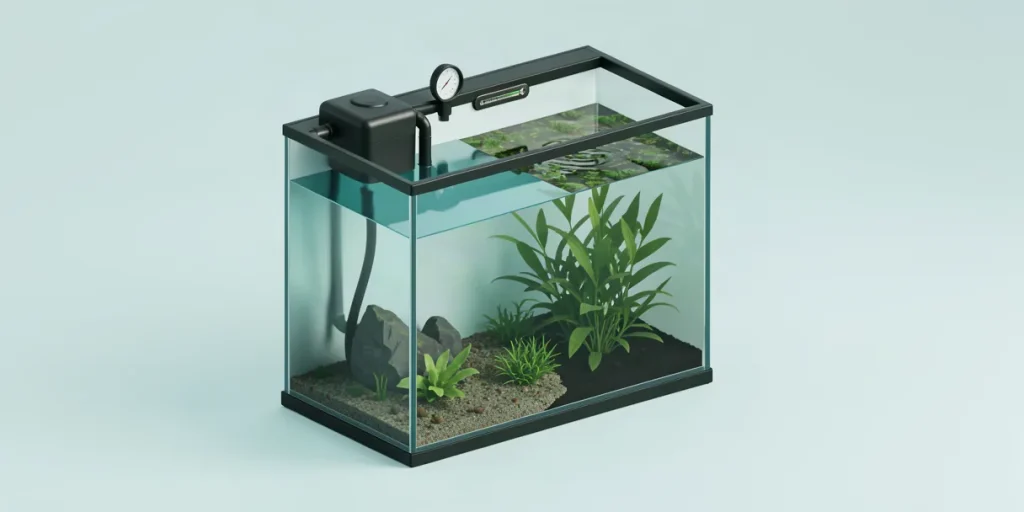
Aquarium problems arise when the balance between fish, water, filtration, and care is disrupted. They may be caused by overfeeding, overcrowding, unsuitable conditions, or a sudden change in water parameters.
Cloudy water, algae, and fish appearing unwell are not always separate issues: they are often signs of the same underlying problem. To understand why problems arise in an aquarium, look not only at the water but also at recent changes in care and your pets’ behavior.
| Volume | What to consider | Suitable for |
|---|---|---|
| 10-60 л | Hard to maintain biological balance | Not the best starting point for a beginner |
| 120-200 л | Optimal choice for a beginner | Beginning aquarist |
| 300 л и более | Requires skilled care | Owner prepared to maintain the aquarium regularly |
| 400-500 л | A large tank requires experience | Not suitable for care without preparation |
- 10-60 л aquarium volume in which it is hard to maintain biological balance
- 120-200 л optimal aquarium volume for beginners
- 300 л и более aquarium volume that also requires skilled care
- 400-500 л volume range for a huge tank that requires experience
Why do aquarium problems start?
Aquarium problems start when the temperature changes, filtration is inadequate, or fish are given too much food. Cloudy water, algae, and low oxygen levels can occur at the same time, so consider each symptom alongside the others.
In summer, heat warms the water, while evaporation changes conditions and destabilizes the environment. Algae may grow faster in warm water, and fish may not get enough oxygen. If the water turns cloudy, check the temperature and filter: the cause could be insufficient capacity, incorrect installation, or infrequent cleaning.
What to check at the first signs of trouble
- Temperature: Compare it with the usual conditions in your aquarium and watch for sudden changes.
- Filter: Make sure it is switched on, installed correctly, and not clogged with debris.
- Feeding: Check whether any food is left after feeding. Uneaten food becomes organic waste and pollutes the water.
- Combination of symptoms: Note whether algae, changes in fish behavior, or signs of low oxygen appeared along with the cloudiness.
Cloudiness alone does not reveal the cause: different problems can make the water look similar. Don’t change conditions at random. First check the temperature, filtration, and leftover food, then assess the other signs.
How does aquarium size affect water stability?
Volume affects water stability: it is hard to maintain biological balance in aquariums with a volume of 10-60 л, so a small aquarium is not necessarily easier to care for.
For beginners, an aquarium with a volume of 120-200 л is the optimal choice. But a larger tank is not for everyone: consider in advance whether you can maintain the filter regularly and change some of the water.
What to consider when choosing an aquarium size
- Space. Decide where the aquarium will go and make sure you can access the filter for maintenance.
- Regular care. Choose a size that allows you to keep the filter running properly and change some of the water.
- Stocking. Choose the number of fish based on what you can care for, not just the space available in the aquarium.
Plan the aquarium’s size and stocking together. Don’t add fish until you’ve considered whether you can keep the filter working properly and care for the water regularly.
What should you check if the filter can’t keep up?
If the filter can’t keep up, check its capacity and installation, how regularly it is cleaned and maintained, then assess fish feeding and water temperature.
Capacity and installation
The filter should be suitable for your aquarium’s volume and installed correctly. If the water remains cloudy, check that the device is working and has been installed properly.
- Capacity: Check the filter specifications against the aquarium’s volume.
- Installation: Make sure the filter is positioned and operating as its design requires.
Insufficient capacity and incorrect installation can interfere with filtration; cleaning alone may not be enough in that case.
Cleaning and partial water changes
Irregular maintenance and infrequent filter cleaning can also reduce water quality. Clean the filter regularly, but don’t replace all the water in the aquarium: routine care involves changing only some of it.
If the water remains cloudy after maintenance, check feeding and temperature. Excess food leaves organic waste in the water, while temperature changes can disrupt aquarium conditions. Reduce the amount of food if some is left uneaten, and monitor whether the water temperature is changing.
How do feeding and temperature affect water quality?
Food and temperature affect water quality: uneaten food pollutes the aquarium, while heat and evaporation can upset its balance and encourage algae growth.
If food is left on the bottom or floating in the water after feeding, remove it and reduce the portion. Organic waste decomposes and lowers water quality, so overfeeding can keep the water cloudy even after cleaning.
What to check in hot weather
When the temperature rises, monitor the thermometer reading and water level. Evaporation changes conditions in the aquarium, and high temperatures can upset the balance and create conditions for algae growth. If the problem persists, check whether overfeeding is continuing and whether the temperature is stable.
Don’t just remove the cloudy water or clean the decorations: if excess food keeps entering the aquarium or the temperature problem persists, the water may become dirty again. First remove leftovers and adjust feeding, then address temperature and evaporation; filter cleaning and partial water changes are also important parts of care.
When does a large aquarium not make care easier?
A large aquarium does not make care easier if you can’t maintain the equipment regularly and monitor its inhabitants: size alone does not guarantee stability.
Aquariums with a volume of 300 л и более also require skilled care. A large tank can have problems with its filter, temperature, and feeding: excess food pollutes the water, while a faulty or incorrectly installed filter works less effectively.
A huge tank of 400-500 л and a nano aquarium both require experience, but the care they involve is different. A large aquarium needs suitable equipment that is maintained regularly. A small tank holds less water, so it is difficult to maintain biological balance—the stable equilibrium between the inhabitants’ waste and the filtration system.
A small aquarium is not necessarily easy for a beginner: biological balance is hard to maintain in tanks with a volume of 10-60 л. Don’t choose one just because it takes up less space.
What to assess before setting up an aquarium
- Aquarium size: Match it to the amount of time you can devote to regular care.
- Equipment: Check that the filter is suitable for the tank you’ve chosen and can be maintained regularly.
- Stocking: Decide in advance which inhabitants, and how many, you can keep while providing proper aquarium care.
Before setting up the aquarium, make sure you can clean the filter regularly and change some of the water.
Frequently asked questions
Why does aquarium water turn cloudy?
What should I do if algae grow in the aquarium during summer?
Which aquarium should a beginner choose?
Can a large aquarium help avoid problems?
Sources
- c.suziria.ua — “Caring for an Aquarium in Summer”
- funfish.ru — “Cloudy Aquarium Water: Causes and How to Deal With It”
- aquariumok.ru — “Aquarium Diseases: Typical Problems When Properties…”
- akvarium-moskva.ru — “Caring for Different Aquariums — Alfaro”
- zoopt.ru — “How to Care for an Aquarium”