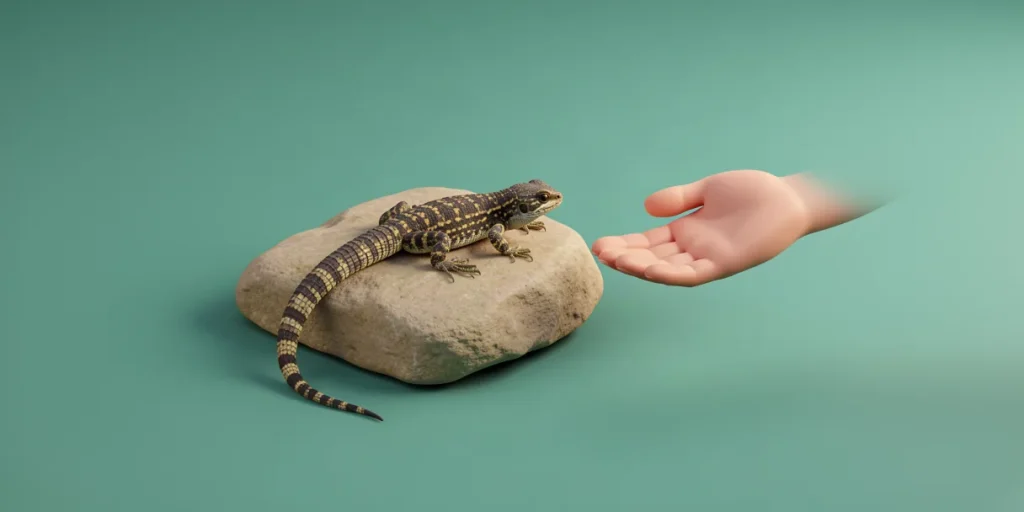
You can recognize trust in a reptile by its calm behavior around people, not by “cuddling” or human-style affection. It may not hide, may calmly tolerate familiar care, and may approach you on its own.
These signs don’t mean that reptiles experience feelings the same way dogs or cats do. Behavior is influenced by species, temperament, and living conditions: being still may signal stress, not calmness. So it’s best to assess reptiles that show affection by looking at consistent behavior and changes in it.
| Observation | Cautious interpretation | What it does not prove on its own |
|---|---|---|
| Calmly tolerates familiar touches on its back and sides | A possible sign of trust | Human love |
| Tries to move away from touch | Contact is unpleasant or not welcome right now | That it is incapable of trust |
| Protects a clutch of eggs | Care for offspring | Affection for its owner |
| Owner reports affection in a survey | A person’s response about their pet | A direct measure of the reptile’s emotions |
- 19 respondents listed a reptile as their pet
- 136 respondents listed a cat as their pet
- 96 respondents listed a dog as their pet
How do reptiles show trust in people?
A reptile may show trust by calmly tolerating familiar touches on its back and sides in a familiar setting.
This response suggests tolerance and trust toward a person, but it does not by itself prove human love. Don’t judge your pet’s behavior by a single episode; consider how it usually responds when you approach and touch it.
Watch your pet’s reaction during contact: if the reptile tenses up or tries to move away, stop touching it at once and let it retreat. Don’t test its trust again until it has returned to calm behavior.
What does the survey of reptile owners show?
The survey shows that reptiles were named as pets less often than cats or dogs: in the sample, 19 respondents listed a lizard, snake, or similar animal; by comparison, 136 respondents named a cat and 96 named a dog.
This ratio describes only the makeup of this particular sample, not the proportion of reptile owners among all pet owners. The figures can be compared only within the responses listed.
The fact that reptile owners took part in the survey does not prove that these animals feel human-style affection. The figures show which pets respondents named, not what reptiles feel.
How is attachment to a pet measured?
Attachment to a pet is measured using a questionnaire for people, not by directly reading an animal’s emotions. The Russian version of the Lexington Attachment to Pets Scale is called LAPS-K: the scale includes four subscales and eight statements.
Responses to the LAPS-K describe a person’s attitude toward their pet. They don’t directly show what a reptile feels: questionnaire results and an animal’s behavior are different kinds of observations.
What you can observe in a reptile
Being calm during contact with a person may be a sign of trust, but it is not in itself the same as a scale result. Some reptiles tolerate being touched; others prefer not to be handled unless necessary. Assess behavior separately from questionnaire responses.
Does caring for offspring mean affection for a person?
A reptile’s care for its offspring does not in itself mean affection for a person: protecting a clutch and watching over hatchlings are part of the animal’s relationship with its own young.
Some reptiles guard their eggs and watch over their young after they hatch. This behavior helps the offspring survive, but it does not show how the animal feels about its owner.
When describing a reptile’s behavior, distinguish care for offspring from trust in a person. The first is seen around a clutch or hatchlings; the second is judged by the animal’s interactions with its owner, not by how it cares for its young.
When do touches not indicate trust?
One calm response to being touched does not prove lasting trust in a person: the pet may simply be tolerating contact at that moment.
Tolerance doesn’t mean that a lizard, snake, or turtle should be regularly handled or petted. Pay attention to the pet’s own reaction, not just the fact that it isn’t resisting.
- If the reptile tries to move away, stop touching it and let it retreat.
- If the pet clearly does not tolerate contact, don’t continue or restrain the animal.
- Some reptiles should not be handled unless their health requires it.
If an examination or treatment is needed, follow the advice of a professional who specializes in reptile health.
How can you interact with a reptile without pressuring it?
Let the reptile’s response guide your interactions: touch it only when it is calm, and stop if it tries to move away or avoid contact.
Petting its back or sides should not become a routine test of trust. Even if the reptile has accepted these touches before, assess its behavior anew each time.
If your pet doesn’t want contact, leave it alone and don’t try to restrain it. Whether you need to handle a reptile depends on its health: if in doubt, first ask a veterinarian whether handling is necessary.
Sources
- petsmart.ru — “Myths About Fish and Reptiles — White Rabbit”
- grazia.ru — “Which Pets Truly Love Us, and Which People…”
- totozoo.ru — “Cold-Blooded Friend: Do Reptiles Feel Attachment to…”
- psy.pinpo.ru — “A Secret Source of Support: Attachment in a Child’s Life”
- zoocool.ua — “13 Tips for Reptile Owners — ZooCool Pet Store”